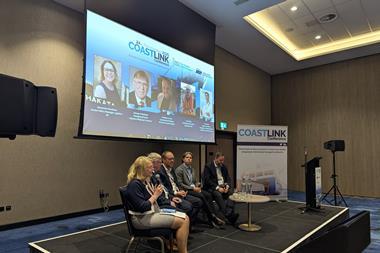
Continuing on the collaborative approach – Coastlink continued into the afternoon taking a panel approach to discuss challenges and opportunities in the sector.
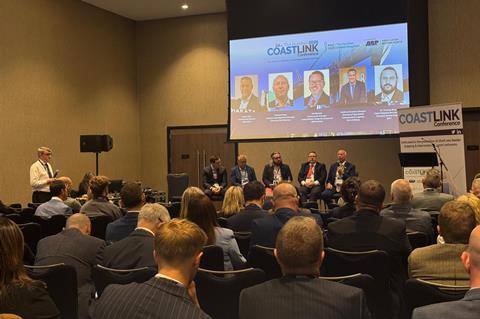
Andre Mast, commercial director, A2B-online Container, kicked off the discussion on growth and transformation in RoRo shipping, with a focus on innovative service delivery models being designed to meet a more customer centric approach.
“Terminal offerings are expanding, customers are asking for better connections and we need to listen – cooperation means we will all be able to grow,” he said.
It’s close cooperation in Rotterdam, he said, which has led to his company’s continued growth.
Expanding cargo diversity
Graham Cross, business development manager, Clarksons Port Services, brought a different perspective to the table.
Clarksons works on behalf of cargo owners, ship owners and manufacturers largely in the oil and gas and renewables markets.
“Our clients are demanding more vessels that accommodate unitised, breakbulk and oversize cargo at the same time. This is challenging for ports because they have physical constraints landside.”
But he said, on the plus side, the introduction of these new types of multi-capacity vessel allows handling to develop in a clever, more innovative way.
He emphasised the need to be able to react to changing demands from clients and guide them in their freight forwarding decisions to make more efficient and more sustainable choices.
Being able to roll with change, while working towards long-term goals was fundamental to the conversation.
Iain Barnett, commercial manager - lead unitised & project cargo, ABP Humber, said that being proactive in chasing efficiency is the right path to follow.
“Ask what the future looks like, for example, LoLo and RoRo are more cost effective seasonally. It’s imperative to build relationships and stay close to customers. It’s about being flexible and agile, but support needs to come at a governmental level too.”
A five-year outlook
When it came to the question about being flexible and agile – the topic of AI and automation was not far away.
The consensus seemed to be that the age of the just in time arrival may be over and AI is key to achieving efficiency and cost effectiveness.
Graham Cross explained that Clarksons has invested in an AI company to better facilitate customer requirements.
He said that AI is unsurpassed in dealing with data and tasks at volume, but for them, it is imperative to also keep the human element for their work which is highly customer focused.
Going forward he said he would like to see more joined-up thinking and more collaborative working across the sector.
For Iain Barnett, another key focus should be on positioning cargo closest to its end destination and that we will be reliant on data as the justification for taking action going forward.
AI will have a massive role to play in this completely different more system-integrated world, he said.
Supply chain resilience
The second panel session tackled supply chain resilience head on.
Richard Newton, client director integrated sales, Automotive Maersk Logistics and Services UK & I, gave a case study on its work.
He pointed out how trade patterns have changed over the last few years in line with geo-political issues such as trade tariffs.
“A new way of working requires strategic partnerships and redefining the new normal,” he said.
He pointed to Maersk’s working partnership with Hapag-Lloyd and the company’s focus on its Gemini network – a modular system for maximising the effiency of port calls and feeder vessel routes.
Feeder vessels, he said, are not prone to the same delays that container vessels are at the larger ports. A larger vessel calling at multiple ports experiencing a delay will have a knock-on effect to all port calls.
For this reason, the traditional model of one large vessel calling at multiple ports has made just in time reliability nosedive down to around 55%.
But Maersk’s Gemini system has achieved a 15% improvement for customers. It works by despatching local feeder vessels to perform butterfly routes around calls at the larger ports to avoid bottlenecks and congestion.
In addition, Maersk’s Prism system guarantees arrival time on a port-to-port basis of around 98% reliability for one single fee. It’s being successfully used by one Japanese car manufacturer to better secure arrival predictability.
Ports as an ecosystem
Tracy Jin, business development manager, Port of Esbjerg, advised that we need to stop seeing ports and shippers as single entities.
“Short sea has traditionally been viewed as a single system, but each commodity requires different operating systems in order to build resilience.”
Esbjerg is known has chalked up a number of successes – It’s Europe’s largest offshore wind base and it’s spearheading carbon capture as a business opportunity for ports in Europe.
Ms Jin emphasised that the port’s success has been largely due to its role as a strategic enabler for a more global network.
“With over 250 companies based at the port, we’ve worked hard at transitioning into a strategic collaborative hub. The future is network based, collaborative systems are key to more resilient and sustainable supply chains. Ports are ecosystems.”
Key take homes from the panel were to look at individual operations at key nodes in a global supply chain and to foster collaboration in order to build resilience.
Panellists said it is also important to continue with the green transition, despite political uncertainty.
Delegates were encouraged to look at taking the feeder approach and encourage customers to embrace the benefits of positioning cargo closest to its end destination.
AI and automation should be used to expedite efficiency but the human element must be kept for customer relations.
There was a great buzz around the session and optimism that when industry is put in the driving seat, anything is possible.
Topics
Related Companies
- Previous
- Next