





Coronavirus: making it go away!
COMMENT: If ever there is a strategy needed, it is a well thought out one to minimise the impact of the coronavirus, writes Mike Mundy.
The big question is, of course, when will it be brought under control, or even better stamped out? There is clearly a lot of effort going into this but as of the time of writing this question the answer remains very much open to speculation.
Work progresses on developing effective drugs to use against the virus. Two HIV drugs are being tested as a potential treatment – they target a protein that helps coronaviruses replicate. Scientists have also identified other existing medications that target this function plus there are a number of international research groups that are working on a vaccine. Three examples are: Inovio, USA which is employing a relatively new DNA technology to arrive at a vaccine; the University of Queensland, which is assessing a “molecular clamp” vaccine and Moderna Inc. of Massachusetts, which is working with the US National Institute of Allergy and Infectious Diseases to accelerate its efforts in identifying a vaccine.
In comparison to the last time the world saw the outbreak of a similar virus in 2003 – severe acute respiratory syndrome (SARS) – China has been much quicker to tell the world what is occurring. When SARS appeared, by the time work on a vaccine gathered momentum the outbreak was nearly over. This time round work on a vaccine has got off to a timely start and at least offers hope if not certainty.
The simple fact remains, however, that for the time being at least the emphasis presently remains on containment. And it’s clear that as of mid-February global supply chains are being progressively disrupted with increasingly worrying consequences.
One of the most influential factors here is China’s prominent status as ‘manufacturer to the world’ – much more so than it was in 2003 which, in turn, has spawned global and more complex supply chains. One indicator – Apple Inc. works with suppliers in 43 countries, all of them recipients of components from Apple’s manufacturers in China.
The world’s biggest smartphone maker Samsung, while producing the larger proportion of its phones in Vietnam, is highly dependent on China as a source of components. The border between China and Vietnam has been subject to closures due to fears over the coronavirus and so the truck transport of components is largely off the agenda, leaving the more expensive option of air transport as the alternative. But not everyone will be able to access air cargo capacity – leading to forecasts of increasing supply problems.
Shipping and port impact
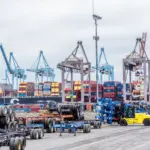
The problems for shipping and ports are well documented – freight rates dipping despite an increasing number of blank (void) sailings and reduced cargo volumes at China’s export ports, in turn lowering the prospects at major US, European and other import gateways.
Respected industry analyst Alphaliner forecasts container traffic at Chinese ports, including Hong Kong, is likely to reduce by over six million TEU in the first quarter of 2020 and forecasts global container throughput would fall by at least 0.7% in 2020.
These are early days in the problematic lifetime of the coronavirus, but we must hope the ‘countermeasures’ contain the problem and a return to normality comes sooner rather than later.
One useful source for ports that highlights good steps to take to reduce the impact of the coronavirus is the Guidance Note on the Coronavirus published by the British Ports Association, available at: https://www.britishports.org.uk/news/wuhan-coronavirus-its-potential-implications-on-the-uk-ports-sector