

EU ETS – alternative fuels catalyst?
Royal Haskoning investigates to what extent the EU Emission Trading System (ETS) incentivises shipping companies to switch from traditional fuels towards low(er) carbon fuels
THE SET-UP OF EU ETS
As outlined by the European Commission, the inclusion of maritime transportation into the EU Emission Trading System (ETS), together with the monitoring, reporting and verification (MRV) of ships’ emissions, is one of the Commission’s main tools to reduce the greenhouse gas emissions of maritime transport. Under the new legislation, shipping companies need to surrender EU ETS allowances (EUAs) for greenhouse gases (GHG) emitted by commercial cargo and passenger ships of 5,000 gross tonnage (GT) and above. This analysis investigates to what extent EU ETS incentivises shipping companies to switch from traditional shipping fuels towards greener fuels. The alternative fuels in scope of this analysis are LNG, e-methanol and e-ammonia.
DEALING WITH UNCERTAINTY
The analysis takes the perspective of the operational costs of a container shipping company and includes 1) fuel costs, 2) charter costs and 3) expected EU ETS costs for different fuel types. The charter costs are included to reflect the premium that container shipping companies pay for investing in newbuild vessels that are powered by alternative fuels, or for chartering those vessels. Royal HaskoningDHV (RHDHV) notes the relevant ‘markets’ for some alternative fuels are not mature (or even existing) yet and assumptions have to be made to assess the operational costs for vessels using alternative fuels.
In order to estimate the future impact of EU ETS, assumptions are made regarding alternative fuel prices and the EU ETS price in 2030/2040/2050, based on reports from IRENA[1] and the International Energy Agency (IEA)[2]. Although there is a high degree of uncertainty regarding these future prices, the expectation is that fuel prices of e-methanol and e-ammonia will decrease going forward as a result of technological development and economies of scale. The future price of LNG – similar to HFO – is assumed to remain constant going forward. Table 1 shows the main assumptions.
| Assumption | Unit | HFO | LNG | e-methanol | e-ammonia |
|---|---|---|---|---|---|
|
Charter price |
USD/day |
62,000 |
HFO +20% |
HFO +15% |
HFO +30% |
|
Emission factor |
tonCO2eq/ton fuel |
3.17 |
2.79 |
1.38 / 0 3 |
0 |
|
EU ETS price |
€/tonCO2 |
73 |
73 |
73 |
73 |
|
Energy density |
MJ/kg |
40 |
48 |
20 |
19 |
|
Fuel price |
USD/ton |
574 |
722 |
1200 |
875 |
Case study: current market prices
The operational costs for a shipping company are calculated for a specific case i.e. sailing from Marsaxlokk (Malta) to Rotterdam (Netherlands) with a 20,000TEU container vessel. Please note this route has a 100 per cent EU ETS application as it is intra-European. Figure 1 shows the operational cost for a shipping company assuming current ‘market rates’ for charter costs, fuel costs and ETS costs. It is concluded that there exists a significant cost disadvantage for e-methanol and e-ammonia powered vessels, which is mainly the result of higher fuel costs (based on the price in HFO energy equivalent).
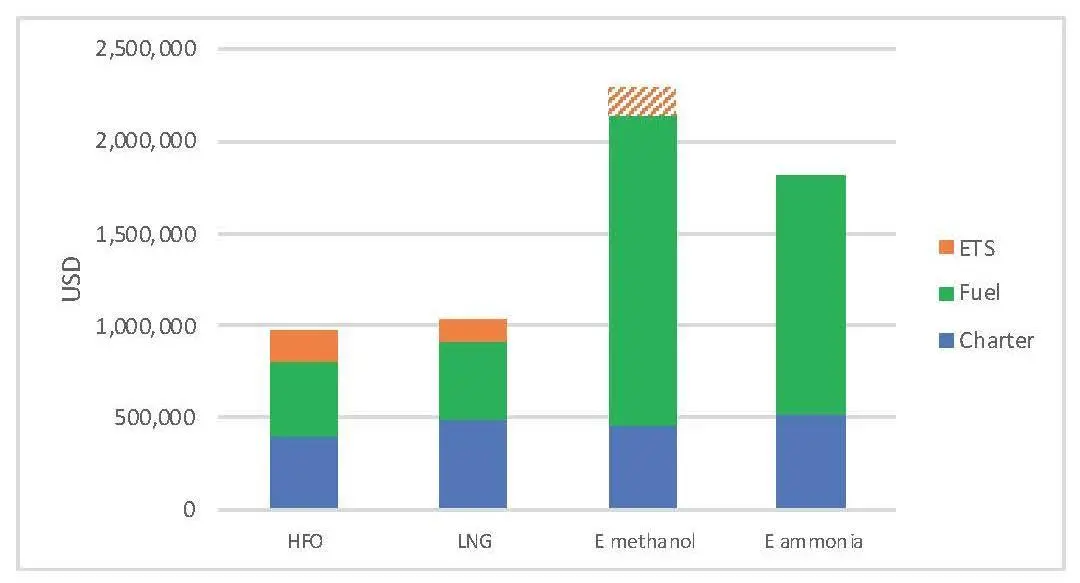
The EU ETS costs for e-methanol are shown dotted in the graph (Figure 1) as the carbon emission factor for e-methanol under EU ETS is still uncertain. The operational costs for an LNG powered vessel are relatively close to an HFO powered vessel. The results show that based on current ‘market rates’, the EU ETS price should be much higher to provide a financial incentive for shipping companies to switch towards especially e-methanol and e-ammonia.
Case study: future market prices
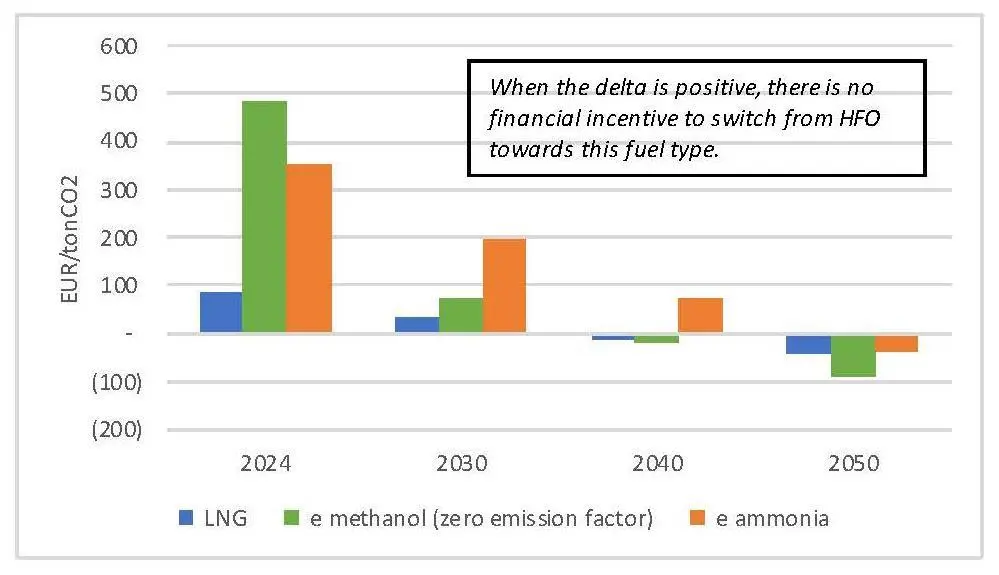
The key question is whether a decrease of alternative fuel prices and an increase of the EU ETS price will promote the uptake of alternative fuels going forward. RHDHV has calculated the ceteris paribus (assuming all else equal) impact of lower e-methanol and e-ammonia prices and a higher EU ETS price. An EU ETS ‘break-even price’ is calculated, which is the theoretical EU ETS price for which the operational costs are identical between an HFO powered vessel and an alternative fuel powered vessel.
If the theoretical break-even price is above the forecast EU ETS price, this implies that there is no financial incentive for shipping companies to switch towards alternative fuels. Figure 2 shows that, based on current market insights, there will be a financial incentive to switch to LNG and e-methanol (assuming a zero-carbon emission factor) by 2040 and to e-ammonia only by 2050.
Please note in practice shipping companies will also take into account non-financial reasons to consider a shift towards alternative fuels, like climate ambition, reputation, or preferences from clients. That said, from a financial point of view, the results of this study imply that for the next years to come relatively high subsidies will be required, albeit for relatively small amounts of fuel. The funding could potentially come (partly) from EU ETS revenues. When the volumes of zero/low carbon fuels used increase. The amount of support needed per unit of fuel could decrease to a point at which it is no longer needed.
WHAT IS NEXT?
Do these results imply that alternative shipping fuels are not forthcoming? Not necessarily. There are several reasons to anticipate an increasing share of alternative fuel powered vessels going forward. Firstly, the European fit-for-55 package also includes FEUM, which provides an obligation for shipping companies to gradually reduce the GHG intensity of their activities. As the FEUM reduction targets become more stringent over time, the required reduction of the GHG intensity cannot be achieved via fossil LNG, given its high carbon emission factor. Secondly, the global IMO strategy on reduction of GHG emissions from international shipping has been updated in 2023 and is far more ambitious than its predecessor. The IMO strategy to reach net-zero GHG emissions by or around 2050 is currently being translated into more detailed technical and economic components. IMO guidelines have a well-to-wake basis which provide a further financial stimulus for alternative fuels compared to the tank-to-wake basis of EU ETS.
Thirdly, several other public and private initiatives are developed or under development to bridge the cost gap in favour of alternative fuels. These initiatives either aim to reduce the future price of alternative fuels (e.g. future EU Innovation Fund subsidies to the benefit of hydrogen and alternative fuel production or contracts for difference schemes initiatives) or aim to better align and aggregate supply and demand (e.g. the German H2Global auctions or green corridor initiatives). The gradual substitution of fossil fuels by zero/low carbon fuels requires both the carrot (EU ETS) and the stick (FEUM, IMO).
[1] IRENA innovation outlook renewable methanol (2021) and renewable ammonia (2022).
[2] IEA World Energy Outlook 2023.
Related Articles
 DIGITAL
 PRODUCTS & SERVICES
 PRODUCTS & SERVICES