![PortStrategy[GreenPort]](https://www.portstrategy.com/wp-content/uploads/2026/09/PortStrategyGreenPort.svg)






Irish port faces capacity challenge
An Irish port has set out to tackle a growth challenge as it estimates it will reach its maximum throughput capacity between 2030 and 2040.
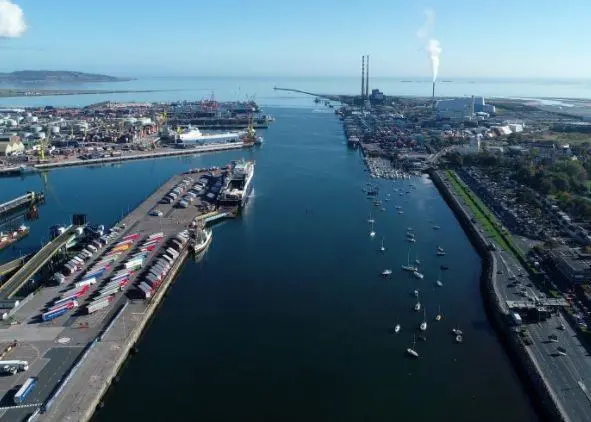
Dublin Port Company (DPC) has said that additional port capacity will be needed elsewhere on the east coast of Ireland to cater for the growth which Dublin Port will not be able to accommodate once its capacity has been reached.
On the basis that building large new infrastructure takes twenty years or more from concept to completion, DPC is now beginning to plan the projects that will be needed if this additional capacity is to be available by 2040.
Eamonn O’Reilly, chief executive of Dublin Port Company, said: “We need to plan for how, when and where additional port capacity might be provided on the east coast of Ireland by 2040.
“We know from experience that twenty years is a relatively short period in the context of delivering large scale infrastructure projects, let alone a once in 200 years megaproject, which the construction of a new additional greenfield port would be.”
New 3FM project
DPC has confirmed it is preparing the 3FM Project, to deliver the full capacity envisaged in the Dublin Port Masterplan 2040. Completion of the 3FM Project is needed to provide the capacity required for growth up to 2040. If the 3FM Project were not to proceed, then Dublin Port would reach its limit closer to 2030.
Development and port capacity challenges have been documented in a series of seven papers called the Dublin Port Post 2040 Dialogue.
Building a new port at a greenfield site to be ready for operation by 2040 (referred to in the Dialogue papers as DP1.5) would cost in the region of €3.9bn to €4.2bn (at 2020 prices).
DPC’s viewpoint – Six key conclusions
From its analysis of the issues covered by the seven Dialogue papers, DPC has reached six key conclusions.
Dublin Port Company must complete all of the projects outlined in Masterplan 2040 to deliver infrastructure with an annual throughput capacity of 77m gross tonnes by 2040.
Critically, this will require planning permission to be secured for the third and final Masterplan Project, the 3FM Project.
The achievement of a throughput of 77m gross tonnes per annum by 2040 will require not only the completion of all of the infrastructure projects in Masterplan 2040; it will also require that the efficiency of port operations greatly increases so that port infrastructure is utilised to its maximum. This will require the elimination of systemic inefficiencies in existing supply chain operations.
Over the next 20 years, additional capacity at other existing east coast ports will be required so that, as Dublin Port approaches its ultimate capacity, volumes which Dublin cannot handle can be accommodated elsewhere.
During these 20 years, DPC will need to work on the DP1.5 project so that it can be brought through the planning process and construction started by about 2033 should that become necessary.
The projects to provide additional capacity in other ports and the project to construct DP1.5 can only be realised with State support – none of the projects and none of the port companies (including DPC) are capable of raising the project finance that would be required.
Move the port?
Another option is that Dublin Port could be moved from its current location, but DPC has consistently rejected this idea over the years. In the Dialogue papers, DPC refers to the megaproject to relocate Dublin Port to another location as DP2.0 and has estimated that the cost to do this would be €8.3bn (at 2020 prices) but that it would be near impossible to get planning permission because of environmental impacts.
Related Articles
 PORT & TERMINAL NEWS
 EXPANSION & DEVELOPMENT
 PORT & TERMINAL NEWS