


CASE STUDY: TRIMBLE OPTIMISES DREDGE AND BUILD PROJECT
Precision in marine dredging and construction works is a prime determinant of an eff ective project solution and one that maximises all-round economic benefi t. In today’s world technology has a major role to play in achieving this, as demonstrated recently by the application of state-of-the-art technological solutions from USA headquartered Trimble Inc. at the port of Kalama on the Columbia River, Oregon, USA. The port, a major export gateway for bulk commodities, targeted the construction of a new 550ft dock at its marina facilities.
Precision in marine dredging and construction works is a prime determinant of an eff ective project solution and one that maximises all-round economic benefi t. In today’s world technology has a major role to play in achieving this, as demonstrated recently by the application of state-of-the-art technological solutions from USA headquartered Trimble Inc. at the port of Kalama on the Columbia River, Oregon, USA. The port, a major export gateway for bulk commodities, targeted the construction of a new 550ft dock at its marina facilities.
Advanced American Construction (AAC) was contracted to undertake the project which had three major components: dredging; pile driving (to support the dock) and dock construction. At the bidding stage of the project, AAC recognised the contribution modern technical solutions could provide to deliver an efficient and competitive project and with this in mind engaged Measutronics Corporation, a Trimble Marine dealer, to work with it to combine the best equipment technology and workflow to guarantee project success. The net outcome of this was as follows:
DREDGING
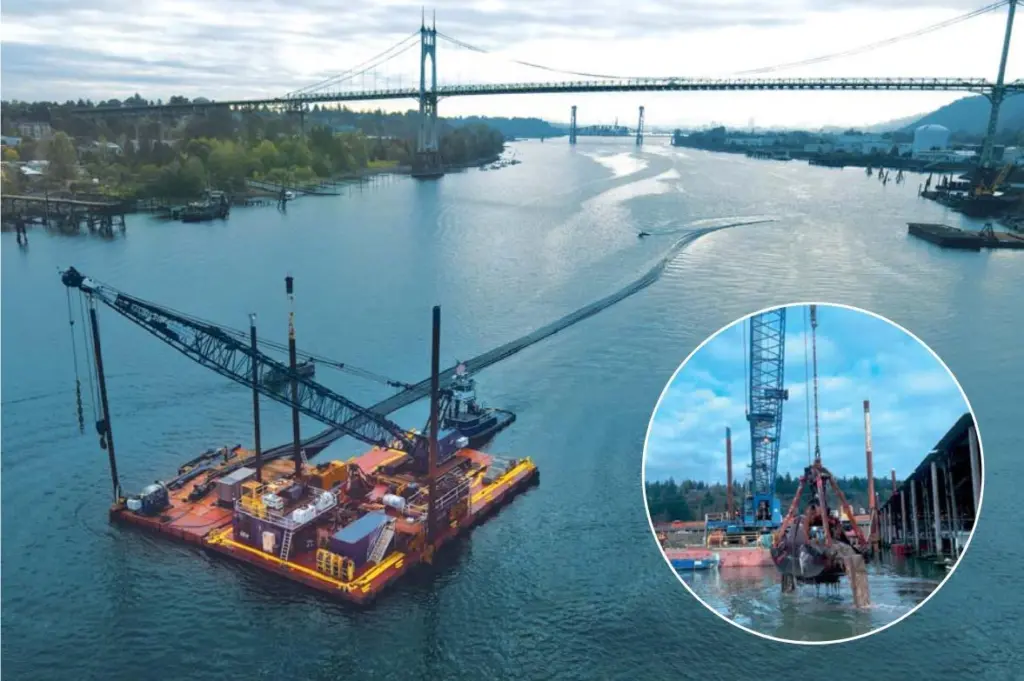
The first phase of the project involved dredging approximately 8000 cu yards of material which included sand, silt, gravel and boulders. AAC and Measutronics determined that a large excavator with suspended pump and bucket and cutter attachments with a crane and clamshell would be a good configuration for the project.
Measutronics equipped the excavator with Trimble Marine Construction, a system designed to optimise the efficiency of dredging and marine and construction workflows, supported by a single beam echo-sounder (SBES) to acquire pre and post dredge survey data.
Evan Clemson, VP Operations, AAC, notes: “Poor choices in managing dredging quantities can raise daily burn rates significantly. Overall, we estimate that we saved 15-20 per cent on the dredging phase by having real-time underwater data versus old school methods of measuring and re-digging, revisiting incomplete areas, or over dredging in certain areas. That is probably a six figure cost saving on a project this size.”
PILE DRIVING
The pile driving element of the project involved driving 25 piles and again a Trimble Marine Construction system was deployed. As Clemson explains: “Using conventional methods, we’re usually within 6-10 inches on a good day. With this project, however, we were shooting for a pile positioning accuracy of two inches. We were also faster. With the 3D data in the cab, the operator had a frame of reference underwater that provided greater confidence, which in turn drove efficiency.”
Overall, three main Trimble technical solutions were deployed: the Trimble Marine Construction system; The Trimble SPS930 Robotic Total Station and Trimble SPS85X GNSS Modular Receiver.
Six clear benefits from the overall project experience are identified: 15 – 20 per cent faster dredging compared to conventional methods; greater pile driving accuracy, faster pile placement, an efficient daily burn rate, improved techniques – vibratory hammer and strong collaborative communication with the project principal.
Related Articles
 OPERATIONS
 OPERATIONS
 OPERATIONS