




Canal expansion fails to meet expectations
Far fewer ships than expected have made the passage from the expanded Panama Canal to US ports due to “insufficient operational resources” within the Panama Canal, the International Organisation of Masters, Mates and Pilots has claimed.
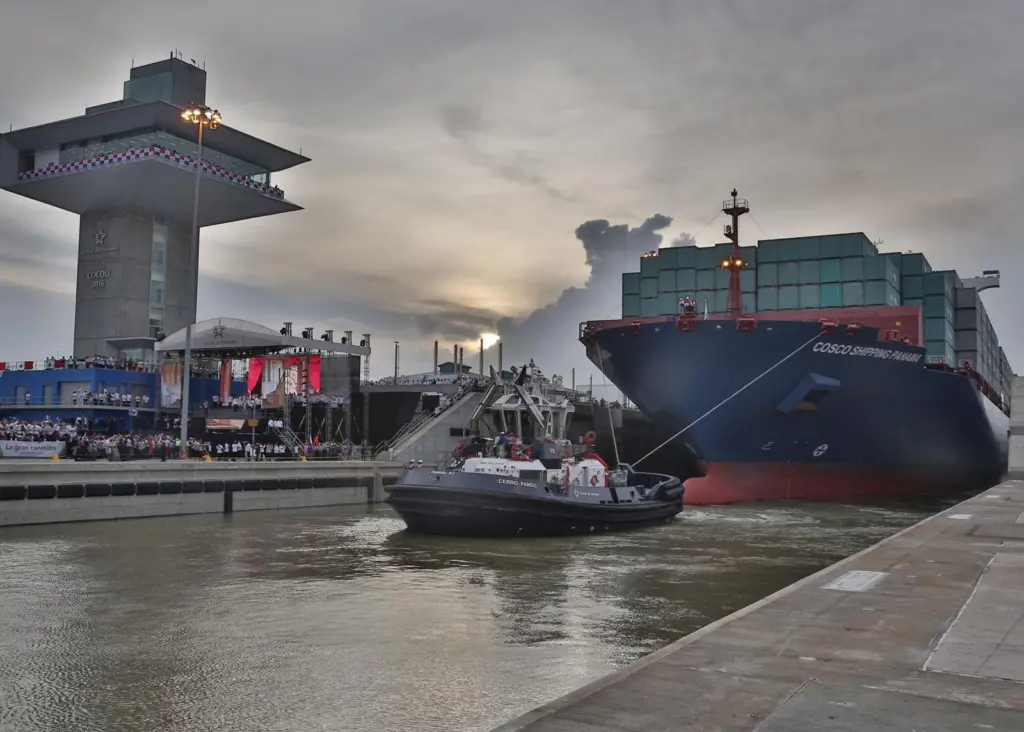
The $9.4bn investment by the Panama Canal Authority in a third set of locks was supposed to double the tonnage capacity of the canal. However, only half of the projected number of ships per day are transiting through the new canal locks due to a lack of staff and infrastructure, the organisation has claimed.
“This is like building a massive office tower without sufficient elevators to carry workers quickly to their offices,” said Captain Don Marcus, president of the organisation.
It was estimated that the canal expansion would require 70 to 90 more powerful tugboats. However, only 33 of 46 tugboats owned by the Authority are operational.
“You would think the Authority would address the problem and acquire more tugboats and train additional crews. They have a canal that’s working at half of its capacity and it is not generating the projected revenues.”
Mr Marcus added that the Authority had hired a Venezuelan company to provide additional tugboats but said that this is not a solution.
“The Authority is at a critical point. Everyone acknowledges that there is a shortage of tugs and trained tugboat captains. In order for the new locks to be a success, the Authority must complete its investment in infrastructure and personnel.”
Mr Marcus added that ports in the US and the UK have made investments based on the canal expansion. As a result, the canal is of “vital strategic importance” and is “critical to trade”.
He concluded that the Authority must live up to its commitments – “It needs to finish the job,” he said. “Failure to promptly address the problem will bring adverse economic consequences to the US and Panama.”
However, the Panama Canal Authority strongly refutes the allegations: “Since its inauguration, the expanded Panama Canal’s performance has exceeded expectations, setting monthly and daily tonnage records, attracting 15 new liner services, and welcoming an average of six neo-panamax daily transits when forecasts originally anticipated two to three transits a day for its first year of operation.
“It is precisely because of the planning, preparation, training, and added capacity that the Panama Canal put into place before the inauguration that has enabled its Expanded Canal to accommodate this unexpected growth in traffic.”
The impact of this strong performance has been reflected in other parts of the world as well, the Authority continued, principally in the ports of the East Coast of the US, which are in various stages of deepening and expanding their channels to meet the growing number of neo-panamax vessels now transiting the Canal.
“As was the case for the Panama Canal, January 2017 was also a record month for several ports on the U.S. East Coast, including Charleston, Philadelphia, and Savannah, which recorded respective volume growths of 28, 34 and 16 percent. Overseeing a fleet of 46 tugboats, the Panama Canal has more than adequate resources to attend the current operations of the waterway and meet the industry’s demand.
“As the industry continues to increasingly rely on the safe and efficient service provided by the new locks, so too will the Panama Canal continue to take steps to improve productivity and ensure it maintains the resources and capacity necessary to meet this growing demand.”
Related Articles
 SOUTH AMERICA
 PORT & TERMINAL NEWS
 PORT & TERMINAL NEWS