

Not if, but when
Theres light at the end of Vietnams dark Cai Mep tunnel. Stevie Knight reports
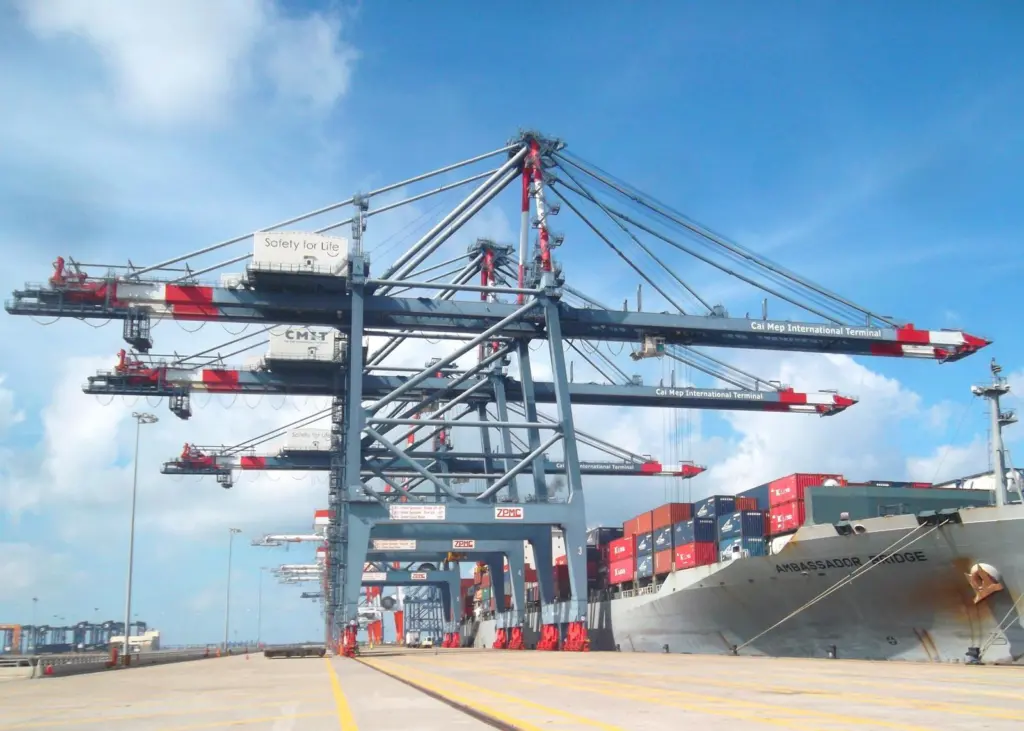
Despite appalling overcapacity and a utilisation rate of somewhere between 30% and 35%, Robert Hambleton of APM Terminals’ Cai Mep International Terminal says the port does have a future, though this future might not shine equally brightly for each of the players.
Vietnam’s big port story has certainly been a difficult one. One consultant describes the area as “still bleeding” with some ports filling the gaps with bulk cargo and others cooling off operations.
However, Mr Hambleton takes a robust view: “It looks as if there’s just too much competition – if you see it in two dimensions. But when the ships get bigger, you have to look at it in 3D, and there are only a couple of terminals, SSIT and CMIT, that can reach 22 boxes across. So when the vessels get to 13,000 or 14,000 teu it will knock out a lot of the smaller terminals.”
He believes this even applies to carrier-supported Tan Cang – Cai Mep International Terminal Co (TCIT) which at the moment hold the largest slice of Cai Mep cargo, due to investment by lines’ partners. When the bigger ships come calling, equity stakes from customers will not be enough to guarantee TCIT’s number one position.
But will those promised big volumes ever come? Potentially, yes. Last year the whole of southern Vietnam, which accounts for 70% of the country’s trade, gained 18% in volume with the Cai Mep region seeing about the same again for the year to date. Further, Vietnam is party to two big trade agreements, both of which are currently being thrashed out for finalisation; the Trans Pacific Partnership (TPP), and the Europe Vietnam Free Trade Agreement. “Once in place they will raise the output of the entire country,” says Mr Hambleton.
He says that although it’s taking some time, the trajectory is still sound “and the reasons that everyone got interested in the first place are still there”.
Extra lift
It doesn’t all rest on Vietnamese GDP: Cai Mep is in the right place to be part of the magic triangle on the US-Europe-Asia route – in fact, CMIT has already gained the Ocean 3’s ‘Columbus’ Service. Further, the Panama Canal will open up to 14,000 teu vessels next year and though Mr Hambleton admits “everyone will have to do their sums” with regards to costs, he believes “a significant amount of cargo” will start to come in on bigger ships.
However, seeing in 3D means down, as well as up, and though there’s 16m depth both alongside and in the turning basin, he admits the draft in the approach channel is a bit shy of what it should be. The original deal was for 14m, 24/7, but the fairway has developed silty high spots that need levelling. “A 14m depth would please our customers,” he says, “they are not so happy at 12.8m.”
To an extent it’s a circular argument. While the area isn’t pulling in the trade, the government isn’t going to be so keen to pay out the money for dredging, but Mr Hambleton is fighting Cai Mep’s corner: “With the trade deals around the corner, ships will get bigger so the need to dredge and reduce port dues will be seen by the government.”
There’s more that will shift the picture: the recent sale of some of Saigon Port’s assets look like being used to develop Hai Phuong. “There’s overcapacity in the south, but it’s a long coastline and further up the country there’s still room for development,” points out BMT’s Dr Mark Yong.
Mr Hambleton adds that the relaxing of the cabotage law could trigger the need for a domestic transhipment hub in CMIT, capturing cargo from Hanoi.
So, when will it all take off? Both Dr Yong and Mr Hambleton are in agreement on this point: Vietnam’s import and export industries will pick up “around two or three years” from the signing of the trade pacts. In which case, 2019 could prove a turning point for the glut of terminals in Cai Mep.
Related Articles
 EQUIPMENT
 PORT & TERMINAL NEWS
 PORT & TERMINAL NEWS