

Cutting edge thinking
Felicity Landon highlights news and experience of interest to the ports sector at London International Shipping Week – energy transition and safety are to the fore
Port authorities, companies and individuals all have a role to play in the energy transition and all must take responsibility, Luc Arnouts told guests at the Port of Antwerp-Bruges networking reception during London International Shipping Week.
One of the key reasons for the merger of the ports of Antwerp and Zeebrugge in April 2022 was the need to focus on energy transition, said Arnouts, who is Vice President International Relations and Networks at the Port of Antwerp-Bruges.
While emphasising the port authority’s determination to take responsibility for decarbonisation, he also acknowledged the challenges. “We are starting to operate the first tugs in the world on methanol and hydrogen. But we need to decarbonise industry and replace with green. It is a huge challenge, to decarbonise the steel and the cement industry.”
He described Antwerp-Bruges as a port that is ‘complementary to the region’ and has three pillars. “We are much more than a port. We are a combination of port handling platform, big industrial complex and huge logistics complex. It is all intertwined,” he said.
“Our role as a port authority is to try to be involved in the global production of green electrons and molecules and as an important base for green electrons and green molecules – we see a very strong role for our port to be a main importer and we have the space for expansion. We have dedicated a particular part of the port for customers that want to invest in the circular economy – for example, recycling plastic waste and chemical recycling. Finally, carbon capture and storage. If we want to reduce CO2 emissions, we have to capture, liquefy and bring this to safe storage. A project we are pushing very hard is to build a liquefaction plant.”
INNOVATION CRITICAL
Ports represent a ‘very traditional’ sector, transporting goods from A to B, said Arnouts, but innovation is of crucial importance. “Over the last ten to 15 years, this industry is really moving forward in an innovative way and putting a lot of money and energy into innovation – for example, the Seafar remote control barges.”
Reflecting on the merger of Antwerp and Zeebrugge, Arnouts noted that this took place after three years of discussions. “Why did it take so long? Because we wanted to go for full integration, and that means you need to integrate everything – ownership, one CEO, one executive committee, a fully integrated structure. I can assure you, it takes time.”
VR & 3D TO ENHANCE SAFETY
A VR (virtual reality) port developed for ABP prompted positive feedback when tested by staff and apprentices – with some commenting that ‘health & safety has become cool’.
The VR port, designed to look like various of ABP’s 21 ports, but not exactly any of them, is currently being used in ABP’s internal health & safety courses. It is being scaled up for use in other training areas, including leadership, plant and equipment, and refresher training.
Saheed Onisemo, ABP’s Health, Safety and Environment Trainer, described the VR project during an ‘Innovation in Port Skills’ event organised by Port Skills & Safety (PSS) during London International Shipping Week.
“Through this VR, I want people to understand where they can and can’t go for health & safety reasons,” he said. “We want to truly understand what people are doing and why they are doing it. When we understand that, we can start to establish and tailor what we are saying in our training courses.”
There were technical challenges when designing the VR port, he said. For example, port users could walk through walls, lampposts ‘floated’ and the early versions were ‘too perfect’, with no cracks in the pavements. The model was upgraded several times before testing.
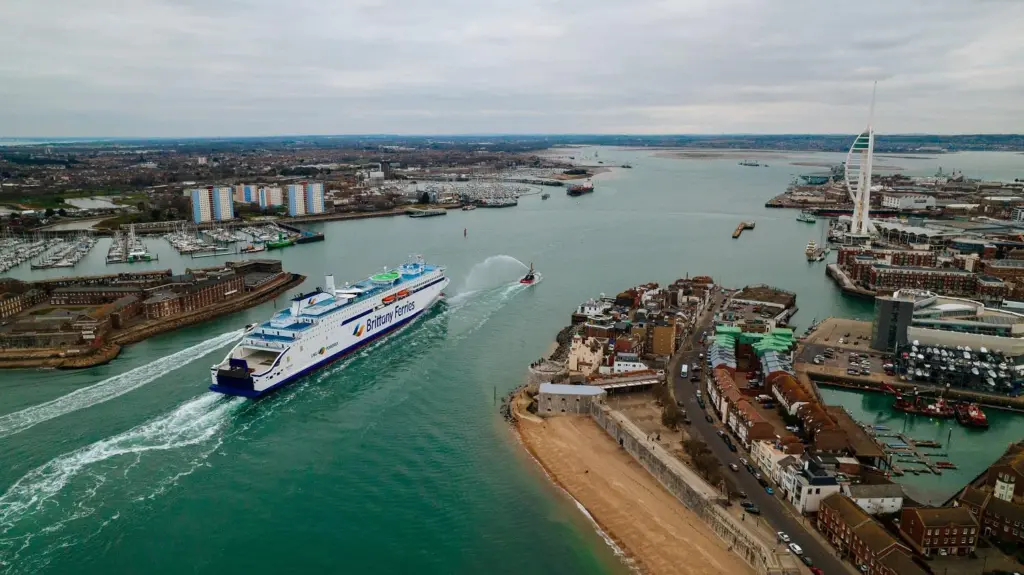
The creation of a 3D map of Portsmouth International Port was described by Chris Hatter, Head of Compliance at Portsmouth. The main aim is to use the technology to avoid accidents and risks – but while it was initially set up for safety, the 3D map is being used for other applications such as interactive and self-learning opportunities for children, practical help for staff, and route directions for drivers who are unfamiliar with the port.
“Using the 3D model and making it interactive is adding a layer of connection to people,” said Hatter. “We can also use the model for training – it takes you around the port and gets people interested.”
Related Articles
 OPERATIONS
 OPERATIONS
 OPERATIONS