





Power source
More ports are turning to renewable sources to power operations, finds John Bensalhia
Grumbling about the weather is a common pastime, wherever you are in the world. A rainy day scuppers any chance of outdoor fun and an overly sunny day can cause great discomfort for some, not to mention the risk of sunburn.
But there are more and more reasons for ports to celebrate the weather and its capabilities – specifically, the way in which the elements can be used as a source of alternative energy. Solar panels and wind turbines demonstrate how the natural elements can be harnessed to provide efficient, cheaper and best of all, environmentally friendly sources of energy.
Alternative energy is big news around the world, as a recent REN21 global status report discovered. The key finding of the 2015 report was that a new record had been set worldwide for renewable energy, thanks to increases in new solar, wind and hydro plant initiatives. The statistics from REN21 also found that 147 gigawatts of renewable electricity went online in 2015, a figure that was recorded as the largest annual growth to that point.
For ports, alternative energy is becoming an ever-popular choice as an efficient solution that’s also an environmentally friendly one. Alan Tinline, Associated British Ports (ABP) head of environment, explains: “Renewable energy is not only a cornerstone of our business but at the heart of powering our business as well. We have a long track record of introducing renewable energy schemes across our ports, particularly solar arrays and wind turbines. These combine to reduce the carbon intensity of our business and hence the offering to our customers as well. In addition, reducing our reliance on grid supply improves our resilience.”
ABP have tapped into wind power through its investment in turbines. For instance, in 2014, a wind turbine was introduced at the Port of Newport, generating 1.46m units of electricity alone in its first half year of use. Following on from the success of the Newport turbine, a second one was announced for introduction in the autumn of 2016. The Port of Swansea was another location to benefit from a wind turbine, using it to power operations at the port to reduce CO2 levels.
Worldwide moves
The Port of San Diego utilises solar energy as part of the port’s commitment to reduce its carbon footprint, says Marguerite Elicone, marketing and public relations representative of the port.
In June 2016, the Port of San Diego completed a project that installed a 167-kilowatt photovoltaic system at its B Street Cruise Ship Terminal. “This project is expected to generate enough energy to power 20 homes and reduce greenhouse gas emissions by 187 metric tons annually,” says Ms Elicone. “The port now has solar systems on both of its cruise ship terminals, its administration building and its General Services facility.”
Because of the environmental benefits that solar power brings, many other port operators and companies have looked to this method for inspiration. A recent example of this is DP World, which announced that work had commenced on the biggest distributed solar rooftop project in the Middle East. In all, 88,000 solar panels are to be installed at DP World’s Dubai facilities, such as warehouses, offices and car parks in Jebel Ali Free Zone (Jafza) and Mina Rashid Port. The first phase of this project is due for completion in 2017, and it’s anticipated that 22,000 tonnes of carbon will be saved on an annual basis. Following the first phase, the next two are set to install further solar panels in Jafza and Mina Rashid.
DP World Group chairman and chief executive, Sultan Ahmed Bin Sulayem, said that in addition to the environmental benefits, the initiative will contribute to Dubai’s Integrated Energy Strategy 2030 (which aims to reduce energy demand by 30% by that date) and the UAE vision 2021 for a sustainable environment, a national initiative for building a green economy launched by HH Sheikh Mohammed Bin Rashid Al Maktoum. “By raising awareness of renewable energy, we are helping work towards a carbon neutral future for the UAE. This project demonstrates the scale of DP World’s ambition to be a world leader in sustainability and we look forward to sharing the learnings across our business and also with our stakeholders.”
Another port operator to use solar power is that of APM Terminals Mumbai, which generates electric power of up to 361,000 kWh per year via roof-top solar panels. The first phase went live January 1, 2016, while in June it moved to the second phase where solar panels were installed on the roof tops of the ship-to-shore crane machine houses with an extra 220,000 kWh being generated a year.
South Carolina Ports Authority has also announced its own plans to use the power of the sun for its Wando Welch and Columbus Street terminals. Two solar panels were installed in the summer of 2016 on the warehouse rooftops of these two terminals.
Cutting costs
Cost is a notable factor for ports looking to use alternative energy solutions. “Installation of the solar systems is helping the Port of Sand Diego reduce greenhouse gas emissions while helping cut utility costs,” says Ms Elicone. “During the fiscal year 2015, nearly 251,000 kilowatt hours of renewable energy were produced from three photovoltaic systems on port facilities. That number will increase with the recent installation at the B Street Cruise Ship Terminal.”
Ms Elicone explains the finances involved in the spending and ultimate cost savings involved with alternative energy solutions. “The port spent approximately $341,000 on the solar power system at its B Street Cruise Ship Terminal. The project was completed in June 2016. The first solar panel installation at the Port of San Diego was in 2009 for the port’s Administration Building. That project cost approximately $211,000. In 2010, the Port spent approximately $269,000 on solar panels for its cruise terminal on Broadway Pier. In 2011, the Port spent about $310,000 on a solar panel project for its General Services Building.”
“In the fiscal year 2014-2015, the Port estimated that it had a cost savings of roughly $251,951 for energy use. This includes the solar panels and other energy-saving measures such as lighting retrofits.”
Ms Elicone adds that ports should consider pursuing grants and other funding sources to assist with alternative energy projects. “At the Port of San Diego, we continuously reach out to our tenants and other customers to educate them about the benefits of alternative energy. Sometimes the return on investment isn’t seen for several years, but the total GHG reduction amounts are what really matters.”
By looking at natural ways of generating energy, ports can not only take daily operations into account, but also the bigger picture. Less carbon emissions means a better chance of a healthier future.
“Ports are key nodes in the supply chain,” concludes ABP’s Mr Tinline. “And, while they are a small part of total supply chain emissions, they play a critical role in creating a sustainable supply chain.”
SAVING ENERGY WITH SPECIALIST VENDORS
Various companies and suppliers in the alternative energy field have been involved in a wide spread of related projects for ports.
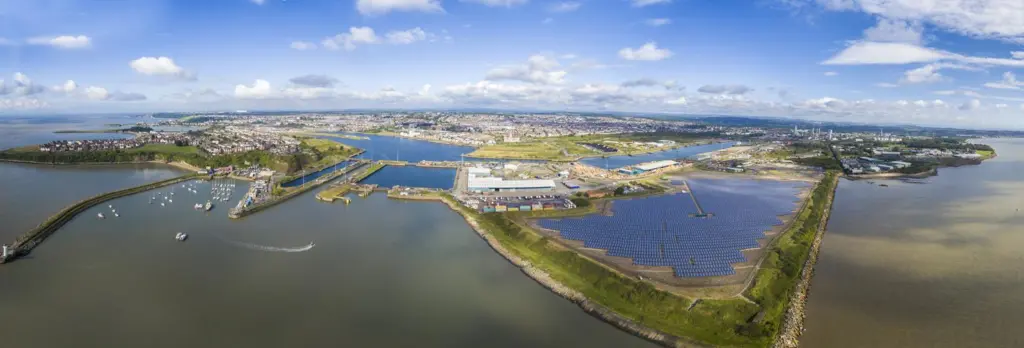
When looking for a solar farm at the Port of Barry, ABP used British Gas Solar to come up with the answer. The result was a 20 acre solar farm that is expected to generate around 4.5 MWh of green energy a year for the port’s operations – any excess energy is then redirected to the National Grid, with about 2,000 tonnes of CO2 saved per annum. British Gas Solar also worked on ABP Newport Docks’ 250 kWp solar project with similarly favourable results.
Renewable energy company TGE Group was used by the UK’s Port of Milford Haven to work towards a large-scale solar PV installation plan. In addition to finding 21 buildings across Milford Docks and Pembroke Port with roof areas that were suitable for solar PV installation, TGE Group also spent six months on design and installation. Ultimately, 2,500 Suntech solar panels and more than 50 inverters were installed to deliver 600 MWh of electricity.
Meanwhile, a notable player in the wind turbine sector is that of Norvento, which installed two 100 kW turbines at Shoreham Port. These turbines are state-of-the-art designs, combining high efficiency with other special features as a low noise mode to generate more than 500,000 kWh of electricity.
Related Articles
 TERMINAL OPERATIONS
 DIGITAL
 OPERATIONS