



Revealing All
Simon Gradassi compares container scanning systems and argues for a step-by-step approach to implementation.
Countering the smuggling of weapons, narcotics, contraband and stowaways is an ongoing battle, with the authorities just about keeping one step ahead of the game. However, whilst sealing and security measures, both mechanical and electronic, are relatively good these days, containers are still vulnerable to having their contents modified en route to a port.
Understandably, the arrival of a container at a port, the receipt of its documentation and a cursory (external) visual examination are not giving port authorities (and the governments of some countries for that matter) sufficient confidence that only the declared contents is about to leave or enter the country.
For this reason, the authorities and governments are increasingly demanding that containers be inspected at ports. For example, in the US, the Container Security Initiative (CSI) is striving to improve security through imposing regulations calling for the pre-screening of containers bound for the US before they leave 47 of the world’s ‘megaports’.
But the detailed inspection of a container can take several hours, and will probably include unloading, examining and then reloading the contents. And, from a port’s perspective, meeting the authorities’ and governments’ demands for heightened security measures is disruptive to the port’s operation. For these reasons, containers are increasingly being x-rayed at ports.
The x-ray inspection of a sealed container is orders of magnitude faster than manual inspection, plus it has the benefit of allowing the inspector to view objects within objects – a la baggage inspection at airports. Furthermore, recent technical developments have delivered ‘material discrimination’ and ‘3D’ capabilities to the inspection, both of which aid determining the contents. Most recently, ‘high absorption alarms’ have been introduced which draw the inspectors’ attention to (perhaps deliberately) densely packed and/or shielded items.
Essentially an x-ray image is created by having an x-ray source on one side of a container and detectors on the other side. The source is either generated (by an ‘accelerator’) or is a radioactive material which emits gamma rays. Of the two, the latter approach, whilst it requires less complex (and therefore lower cost) equipment compared to the traditional approach, is struggling to find acceptance in container inspection. Many operators are refusing to work in the vicinity of a radioactive source. Plus, there are security issues associated with having radioactive material on site. Indeed, the International Atomic Energy Agency recently issued a report pertaining to the risk of theft of radioactive material and of it being used to make a so-called ‘dirty bomb’.
Traditional x-ray sources (accelerators) for cargo inspection are typically rated in mega electron volts (MeV) and the general rule is that the higher the energy level the greater the penetration and clarity of image. For example, a 9MeV x-ray source can penetrate up to 410mm of steel and easily see through densely packed containers.
However, if the containers are to be x-rayed with a high energy source , the building in which the containers are to be x-rayed needs to have shielded walls and doors in order to meet strict international safety standards governing the use of high energy x-rays.
To this end, the majority of high energy inspection systems (inspection tunnels) are housed in purpose-built structures: a number of which are currently in use around the world at ports including Le Havre, Hamburg, Rotterdam, Yokohama and Jakarta.
Portable
Whilst the importance of x-ray inspection is becoming widely acknowledged, the construction of ‘permanent’ buildings to house the x-ray inspection tunnels is not always desirable or practical. Indeed, many operators desire the ability to reorganise the layout of their ports in order to cope with changes in throughput.
For this reason, the last few years have seen a rapid uptake in socalled ‘relocatable’ layouts: effectively prefabricated buildings used to house x-ray inspection systems with energy sources up to 6MeV (which can penetrate up to 330mm of steel). Such relocatable systems can be dismantled and reassembled within a matter of weeks.
One port currently using a relocatable system is Tema in Ghana – where port officials are destination-inspecting trucks and freight for contraband, drugs, weapons and radioactive materials. Also, at Folkestone (Eurotunnel), customs officials are using a 2.5MeV relocatable system to complement their 5MeV inspection system which is currently housed in a permanent structure.
Furthermore, by the time the energy levels are down to 4MeV or less it is possible to have a completely mobile system – a truck with an x-ray boom which reaches over the container it is inspecting. Such mobile systems are in use at, amongst other ports, Baltimore, Veracruz, Dakar and Antwerp.
Inspection Rates
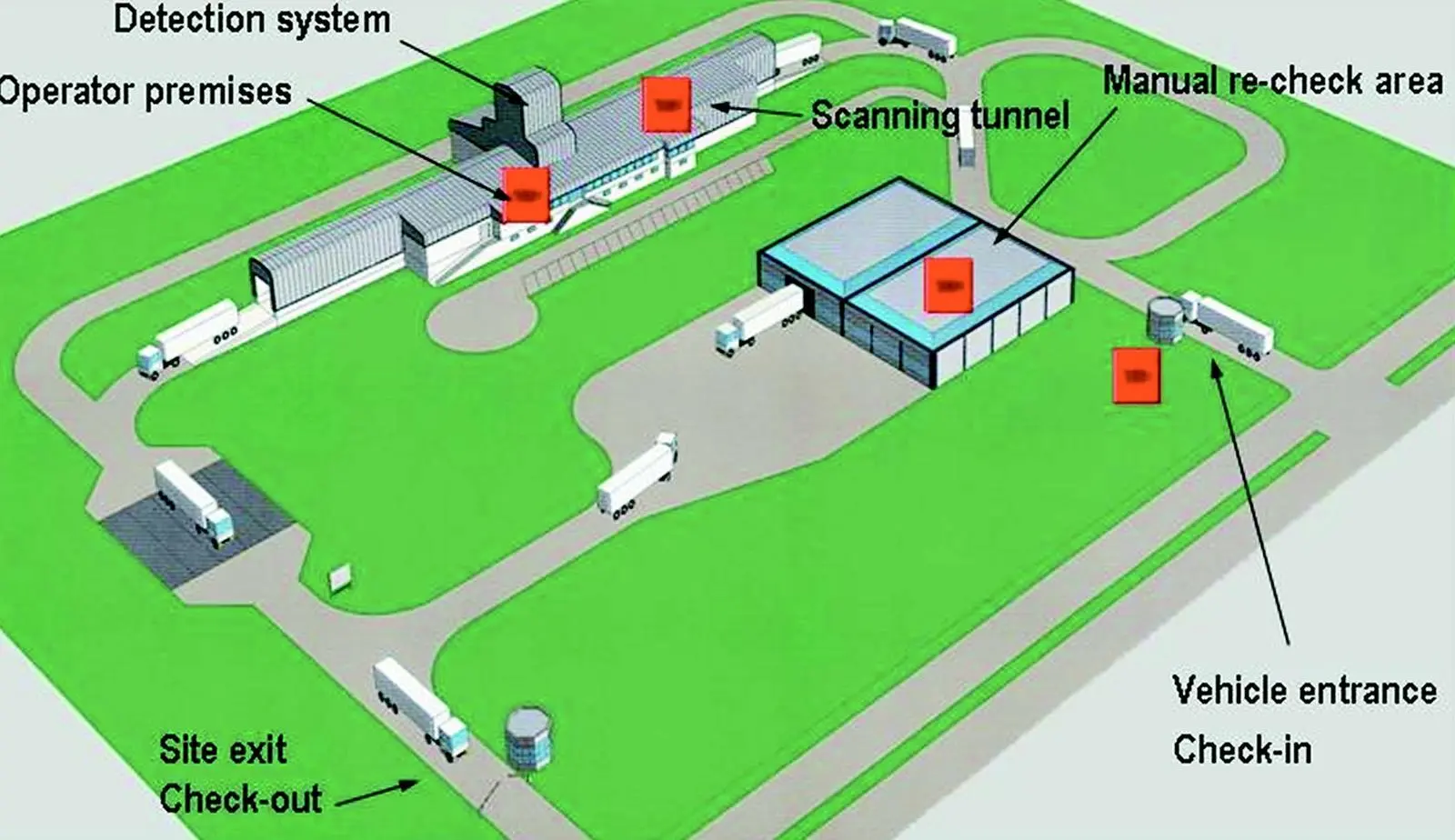
Clearly, as with most security measures, an x-ray-based inspection system must be as non-disruptive (to the flow and throughput of vehicles) as possible. A typical inspection scenario for a fixed or relocatable system would be:
The truck drives through the Check-in point. The manifest is scanned and all information about the truck and cargo is registered.
The driver drives his truck to the entrance of the tunnel and awaits scanning authorisation.
The driver drives his truck into the tunnel and then exits the vehicle and the tunnel;
The tunnel’s doors close and the truck is scanned, with either the vehicle or x-ray system moving at a speed that allows the average container to be scanned in less than one minute;
The driver returns to his truck and removes it from the tunnel to await the results of the scan;
The scanner operator, who has a range of image enhancement tools at their disposal, inspects the x-ray image against the truck’s paperwork; and If nothing looks suspicious, the driver is authorised to proceed.
In general, about 30 trucks per hour can be processed and the analysis of the contents is performed while the container is leaving the tunnel, with a number of operators using one or more of the following tools:
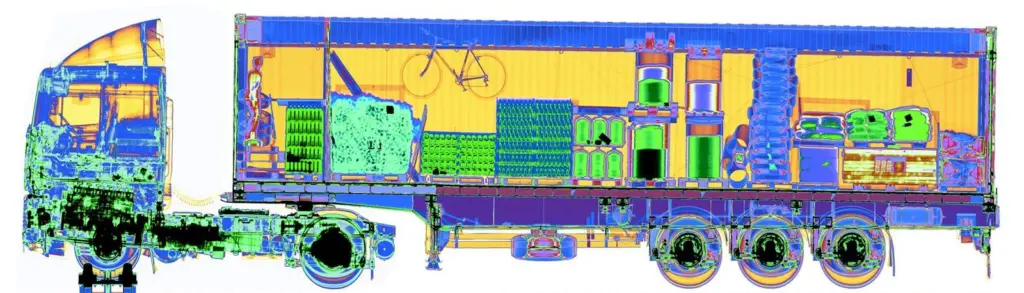
At least one Review Image Workstation (RIW) is used by an operator to view and process the scanned image. Figure 1 shows the image produced by a Smiths Detection HCV-Stationary system. The RIW also allows the operator to call, from a library of images, views of similar cargo in order to perform a side-by-side comparison.
A Check-in Workstation allows an operator to scan the manifest and to complete the data form related to the truck/container.
A Re-Check Image Workstation (RCW) provides a supervisor the means of checking, in detail, the contents of any truck flagged as suspicious; and A Supervisor Workstation (SW) allows a supervisor to check and audit the activity of each operator.
Personnel, Training and Maintenance
The number of operators required will of course vary with the number of x-ray systems (and image work stations) installed. For instance a mobile system excluding the driver, could get by with a single operator.
Static and relocatable systems require many more operators.
Furthermore, as container inspection is typically performed round the clock, the number of operators could easily be triple assuming 3shift operation. However, this resource needs to be compared to the number of personnel that would otherwise be required to unload, inspect and reload the containers (in as fast a time as x-ray inspection).
As for training, most x-ray inspection systems are sold with a ‘training package’. However, training is frequently conducted at the port and most equipment manufacturers now have dedicated training centres such as Smiths Detection’s training centre in Paris. Many of the trainers are experienced customs officials and not only teach the operators how to use the equipment but also where to expect to find illicit items.
Another personnel issue relates to maintenance. Most of the maintenance required is what one would expect for a building containing machinery, sealing doors, moving mechanical parts etc.
Specialist maintenance and servicing of the x-ray equipment falls to the equipment manufacturer.
To X-Ray, or not to X-Ray
The inspection requirements and the number of containers passing through the port for any given period will of course drive the number, and type, of x-ray systems required: both in terms of structures/ buildings and workstations. This in turn will govern the number of operators required.
Regarding the general adoption of container and truck x-ray inspection technology, no one solution will fit all ports because of different port layouts, throughputs and regulations. Hence, many port operators are of the opinion that embracing x-ray inspection will be a major headache and that they ought to make the drastic transition from having no x-ray inspection capability at all to having a fully operational and integrated solution.
However, adopting x-ray inspection technology is, thanks to experience and support from equipment manufacturers, not difficult.
Nor does it require an all-or-nothing approach. Indeed, the “if we’re going to do this we’ll do it all in one hit” mindset is a) delaying adoption of the technology and b) not the best long term solution.
The author is Smiths Detection’s HCV marketing manager.
Related Articles
 TERMINAL OPERATIONS
 DIGITAL
 OPERATIONS