


SEAL OF APPROVAL
John Bensalhia investigates the latest innovations with container seals and assesses the financial and practical considerations involved.
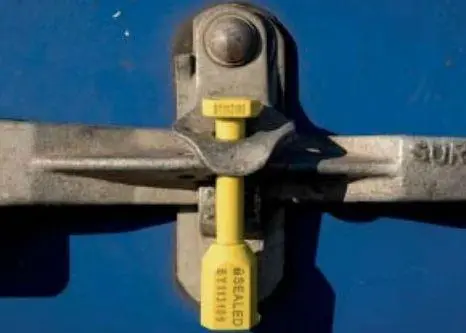
Contamination, damage or theft to the contents of a container are all potential threats with this form of transport. One effective solution to avert these issues is the container seal, which – as Debbie Hardy, National Sales Manager, Mega Fortris UK Ltd, says – plays an integral role in securing and protecting cargo in container transportation and logistics. “Seals are used to secure containers, thereby protecting the goods from potential theft, contamination, loss, etc, during their land and sea routes. Essentially, if a container is sealed by an ISO 17712 certified Bolt or Cable Seal, it provides an added layer of security for the contents and acts as a deterrent for potential fraudulent attacks.”
“The main benefit of container seals is the security,” agrees Niels Pas, CEO, Hoefon Security Seals. “A container seal bears a unique print such as a logo. Once a producer ships the cargo, a seal is placed on both the ship documents and the containers. Seals are produced to the relevant standards and certified in order to be eligible (such as C-TPAT).”
“All container seals offer various levels of security,” concurs Spencer Davis, General Manager, EMEA region, TydenBrooks. “The most important factor of a security seal is to conform to customs regulations while showing clear evidence that the container has not been tampered with. The benefits are to stop illegal/forced entry of the container.”
COST BENEFIT
“There is a clear cost benefit to using container seals,” says James Mulvale, Business Development Manager, Talisman Security Seals. “For pennies, a single seal means you can ensure that the contents of your container are not tampered with in transit. Once a seal is applied to a container, there is no way to remove it without breaking the seal, which will show that the contents have been accessed. Seals are also printed with a serial number, so you can be sure that a seal has not been broken and replaced in transit.”
Cargo thefts entail multi-billion annual losses. While buying a cheaper container seal saves money in the short-term, in the long run it can prove to be a more expensive solution.
COMBATING ORGANISED ATTACKS
“European and UK road transport is the target of organised criminal attacks and security breaches from which significant financial losses can accrue,” explains Hardy.
“Everyone appreciates that logistics operations are constantly challenged to reduce operating costs, which can lead to cheap and low-quality security seals being purchased. The reality, however, is that the difference between a high-quality seal with enhanced security and tamper evident features, and a low-quality seal may be a few pounds or pennies, however the cost of a container full of goods can be thousands of pounds.
“The higher the level of security of a seal, the greater the protection and commensurately reduced chance of having goods compromised and consequent financial loss.”
Davis highlights the point that despite the availability of electronic seals, TydenBrooks finds that many customers are not prepared to pay a premium price for this technology.
With that in mind, the International Seal Manufacturers Association (ISMA) has introduced the industry standard – marked with an ‘H’ on the seal for High Security for shipping cargo.
For all seals there are two basic requirements that must be met, as Davis confirms. “Does it meet ISO 17712:2013? and Is it a Customs Accepted Security product? All our container seals meet these criteria.”
INTRODUCING…
Mega Fortris reports new container seal products. The first is the Klicker 2K Bolt Seal, to combat theft in transit. Hardy explains: “It is the latest Bolt Seal design which provides high-tamper evident features and is also the world’s first container bolt seal to feature two colours in its high impact plastic design. The two unique colours act to enhance product definition, visibility and identification and also prevent cloning.”
Further, she points out that there are two core tamper evident features applied to this seal: “Firstly, the one-way locking system that stops the twist and spin attacks which can be conducted on bolt seals. Secondly, the seal is designed with a safety feature to trigger indicative tamper evidence as per ISO17712:2013 Clause 6. Any attempt to attack the seal will result in a crack in the designated weak spot in the ABS plastic thereby highlighting the attempt to tamper with the seal and thus indicating a potential security breach.”
Another new product from Mega Fortris is the MOST Tracking Device, which provides real-time monitoring and updates for all external influences affecting cargo movements.
“Fixed to the inside of the container, the device uses a GSM network connection which uploads sensor data and location to the internet, making all information constantly accessible via the control panel,” explains Hardy.
“Uniquely, this device is equipped with four digital sensors which detect and monitor the temperature, light, humidity, shock and location during the journey of the container.”
R&D CRITICAL
Pas says that the container seal market is a traditional one and has been this way since the early days in 2001. “It’s a cost-based market that provides good quality products. However, as long as the economy recovers (in the wake of the COVID-19 pandemic), we predict that the market will grow in the future with this encouraged by new designs and innovations.”
As criminals constantly evolve ways to compromise container seals, providers of these products are working to develop seals with higher levels of security and tamper evident features, confirms Hardy.
Davis agrees: “The use of container seals is our security bridge between allowing us to track goods in a container that need to be safe and secure, from departure to arrival. The security chain is extremely important. COVID-19 has taught us that as the pandemic bites more into the economy, we must be more vigilant and more security-minded. We have to reduce potential theft from containers, but not take our eye off the ball for another potential terror attack.”
Track and trace initiatives building
In the early stages of development is Hoefon’s GPS (Global Position System) chip, which is integrated with the plastic of the seal, so it is not visual. The product is in the developmental stage but expected to be available in the next two to three years.
Container seal technology is making sure information levels are higher than ever before. “The latest innovations at Talisman have been in the printing on a seal,” says Mulvale. “Whereas you used to just be able to fit a serial number on a seal, you can now have a QR code printed, which contains a lot more information.”
A major aim for Talisman is to improve sustainability. “The idea of single use plastics is far from appealing, so we are developing new products made from recycled and bio-degradable plastics,” confirms Mulvale.
TydenBrooks’ latest designs include an electronic security seal and an RFID security seal range, according to Davis. “These new seals offer additional security features to provide real-time data to our customers in the freight and logistics business sector.”
TydenBrooks is also developing a track and trace system, which will allow customers to track orders, seal numbers and outstation ordering processes.
Davis states: “The new process will ensure encrypted security delivery services with high-end reports that our customers can download from any part of the world to ensure their network of containers are safe from cloning.”
This is a crucial factor. Hoefon’s container seals are reported to be clone-resistant, thanks to a factory logo embedded in the mould. The Hoefon container seal with a Check Digit Barcode, whereby a random Check Digit is added using an algorithm at the end of the barcode, is growing in popularity confirms Pas, and adds, “Another innovation is a non-removable 3D hologram sticker which is printed on the ball seal, providing remote authentication.”
Related Articles
 TERMINAL OPERATIONS
 DIGITAL
 OPERATIONS