



The Reel Deal
Crane reel system suppliers are responding to modern day design requirements and building healthy order books. John Bensalhia reviews the sector
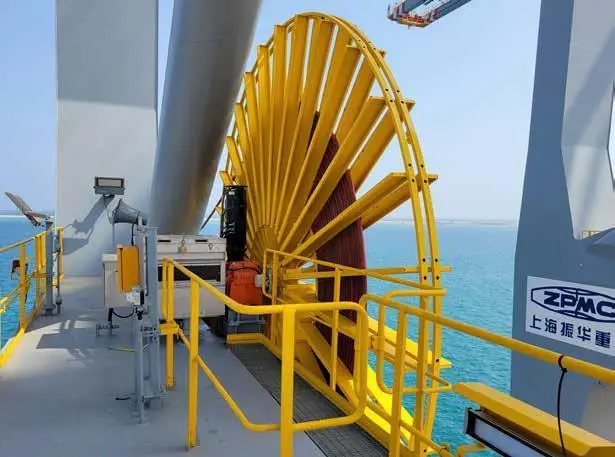
For Conductix-Wampfler GmbH, continued high demand for cable reel systems is fuelled by three overlapping trends. In the short-term, by congestion in container terminals and high margins in this sector; medium-term, conversion of diesel applications to electric drive; and long-term, generalisation of container transport by land.
Damian Russell, VP Product Management, Reels Technologies, Ports and Maritime Cavotec, comments in a similar vein: “We have been fortunate to secure several orders in recent months, notably from long-term Cavotec equipment owners. We have open orders for 15 cable reel systems for Georgia Ports Savannah. We also have a couple of orders with challenging conditions, especially for spreader cable reels, with restricted space availability on the crane trolley for installation of the spreader reel.”
Conductix-Wampfler has also received multiple repeat orders, as Olivier Ruelle, Global Product Manager Reeling Systems explains: “Our customers trust our reels because they will support the application during its lifetime, and we will be there to support anywhere in the world if a problem arises.”
A major advantage claimed for the cable reel is its flexibility for STS container crane power supply. Stemmann-Technik argues “Conductor bars are constantly in the way, while a hybrid system would not bring enough power for a constant operation, considering the emission efficiency.”
Generally, the company also notes: “Electrical cranes reduce energy consumption compared to diesel systems, reduce maintenance cost and wear and tear. It helps also to automatise the operations of the cranes, making this capable for future remote systems.”
REEL ADVANTAGES
Cable reels are claimed to have the advantage over other STS container crane power supplies due to their long-term proven reliability and easy maintenance concentrated in one spot. “Cable reels are the only practical means to feed MW power and Gigabits/s of data 24/7 to container cranes,” says Michael Kusch, Head of Global Marketing & Communications, Conductix-Wampfler. “Diesel power,” he does acknowledge, “is being retrofitted due to maintenance costs and CO2 emissions and high voltage conductor bars are used in a few terminals.”
“A key advantage of our cable reels,” he elaborates, is their reliability constructed and continuously developed based on decades of experience and on customers’ feedback, both electrical and mechanical, HV sliprings and Transmitter Fiber Optics (TFO). Our TFO adds its very high reliability to the secure and practically unlimited bandwidth data transmission through optical fibres.”
Russell concurs that cable reels are long established as the most reliable power supply solution to STS cranes. “Existing brownfield terminals may continue with older technologies like bus bar systems installed in trenches for new cranes, but these types of systems require more maintenance and are more susceptible to wet or dusty environmental conditions,” he says.
TODAY’S DESIGN REQUIREMENTS
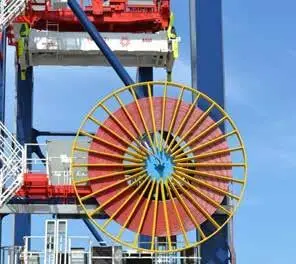
Modern cable reel design criteria include a light weight and design to endure harsh environments with material robustness, higher data transmission, remote access facility, higher accelerations/speeds, and predictive maintenance with associated cost reduction. “We have also noticed a very good response from the customers regarding our commissioning time,” says Konstantin Schultheis, Key Account Manager, Stemmann-Technik. “We have a very easy, ready to plug and start powering system, allowing savings up to five days on commissioning, comparing to the next best alternative.”
Reliability takes precedence in today’s design requirements. For Conductix-Wampfler, this applies to power supply and data transmission.
“Reliable, real-time data transfer equals the importance of reliable power in automated and remote-controlled applications: if something might go wrong in the automated operation, the operator must be able to take control, get a complete understanding of the situation in a split-second from multiple real-time on-board cameras and sensors, and get his commands executed the next split-second, without latency, contention or hacking,” emphasises Conductix-Wampfler.
More Cavotec customers are placing a premium on reliability of the cable reel systems, to maintain crane uptime. “We also see requests for redundant drive motors and controls so that the cable reel can continue to operate, either at full or some reduced capacity in case of component failure,” says Russell.
“A sound, simple and solid mechanical and electrical design is the mandatory basis to construct reliable cable reeling systems,” explains Kusch. “For example, we systematically use cast iron cases for gearboxes for STS to better guide the shafts and gears and better support the bearings, and we systematically protect our mechanical and electrical components against moisture.”
Conductix-Wampfler avoids engineering-to-order, focusing on defining modular ranges of products that use standardised, industrialised components. “This allowed us to invest a lot in the reliability engineering of our reels’ components and test them equivalent to 20 years operation on a set of long-term test benches,” the company says.
A recent addition for Conductix-Wampfler is the Condition Monitoring/Predictive Maintenance options on its KHD series to enable early detection and fast repair of mechanical wear on unmanned cranes.
Stemmann-Technik developed its specific Active Acceleration Control (AAC), helping to predict ‘stop & go’ movements with high (de)/accelerations. “This is all about the control and the deep know-how about the crane’s behaviour, which we have gathered over the last decades. Our AAC system is constantly analysing the data, allowing for stepless torque adjustments. It protects the cable from oscillation and slacking. A system can be 100 per cent redundant without cutting the crane’s operational efficiency.”
Cavotec’s cloud based IoT platform, ‘Cavotec Connect’, can offer enhanced monitoring of its equipment for predictive/preventative maintenance or remote monitoring and troubleshooting. “We have a suite of sensors that can be used, for example, in conjunction with shock/vibration, temperature, humidity, and arc-flash.”
Specified cable reel design upgrades or changes are possible. Stemmann-Technik says that it is keeping the widest range of cable portfolio to meet specification requirements. “If the crane upgrade or refurbishment is made, it requires changing the design of the cable reel. Drawing on long experience, we do it almost automatically/simultaneously, having enough solutions for all requirements and cable types. If the number of cores (copper or fibre optics) is to be increased, we also have to update the slipring assembly,” says Schultheis. “In some cases of crane upgrades, replacing the complete reel is the most economical solution. On the other hand, in case of refurbishments, control program adjustments of our systems will already fulfil the requirements.”
IRONING OUT SNAGS
A potential problem encountered with cable reels is cable snagging. Stemmann-Technik reports it uses robust, specially designed profile spokes to avoid any deflections of the cable reel body. “We implemented the AAC, fine-tuned cable control system in order to keep the cable tension as constant as possible. Besides this, we work with compliance of the cable bending radius and avoidance of any cable’s torsion/twists. With our solution, the problem of cable snagging is widely reduced.”
In the same context, Russell notes: “To prevent the cable getting stuck or pinched, the spacing between cable drum spokes must be set correctly, with a small clearance around the cable. The same goes for the cable trench dimensions, or a product like our Panzerbelt cable protection system, where we dimension according to cable diameter and an allowance for lateral clearance between the crane rail and wheel flanges,” says Russell. “Cable guides and rollers need to be maintained to minimise friction during reeling of the cable.”
He continues: “If the cable path is clear, then the torque generated by the cable reel drive system must be well regulated to maintain correct cable tension. “Most cable reels are VFD (variable speed drive) controlled, which gives the best torque control and lowest operating cable tensions. Cable life can be maximised by keeping cable tensions low as possible.”
If a customer requires a larger cable reel, Stemmann-Technik says that while there is no physical border for the cable reel itself: cable deformation is the challenge. “For European projects, we are facing cable reel bodies with an average of 7m. Depending on the cable dimensions, we can cover around a 1200m quay length considering power feeding at the centre of the track.”
The reducing factor, Stemmann-Technik elaborates is “the physical property of the cable which is not stable enough to keep its shape in the inner layers of the cable reel. Those layers have to carry the weight of 1.4 tons and are deformed.”
Related Articles
 DIGITAL
 PRODUCTS & SERVICES
 PRODUCTS & SERVICES