

Tug profile provides challenge for clean and efficient operations
The operating profile of a typical harbour tug could almost have been designed to maximise emissions; so the ‘green’ tug concept presents a challenge to ship designers, but it is a challenge they are accepting, with success.
Tugs need to work at a range of powers, from idle, when standing by awaiting orders, through low power, when transiting and running light, to very high power when assisting ships. Diesel engines are typically only efficient at high power, i.e. above 50% of maximum output. This means a typical diesel tug is, effectively, wasting fuel and producing unnecessary exhaust emissions for the majority of the time.
Increasing focus on lowering emissions of oxides of sulphur (SOx) and nitrogen (NOx), cutting visible smoke and particulate matter (PM, i.e. soot, in the form of unburned hydrocarbons) and reducing a port’s overall carbon footprint, are focusing attention on tugs as a source of pollution, so over the last few years several ‘green’ tugs proposals have been put forward, and some have reached fruition. Most ports are close to urban areas, and vessels – including tugs – are a major contributor to pollution.
Use of LNG
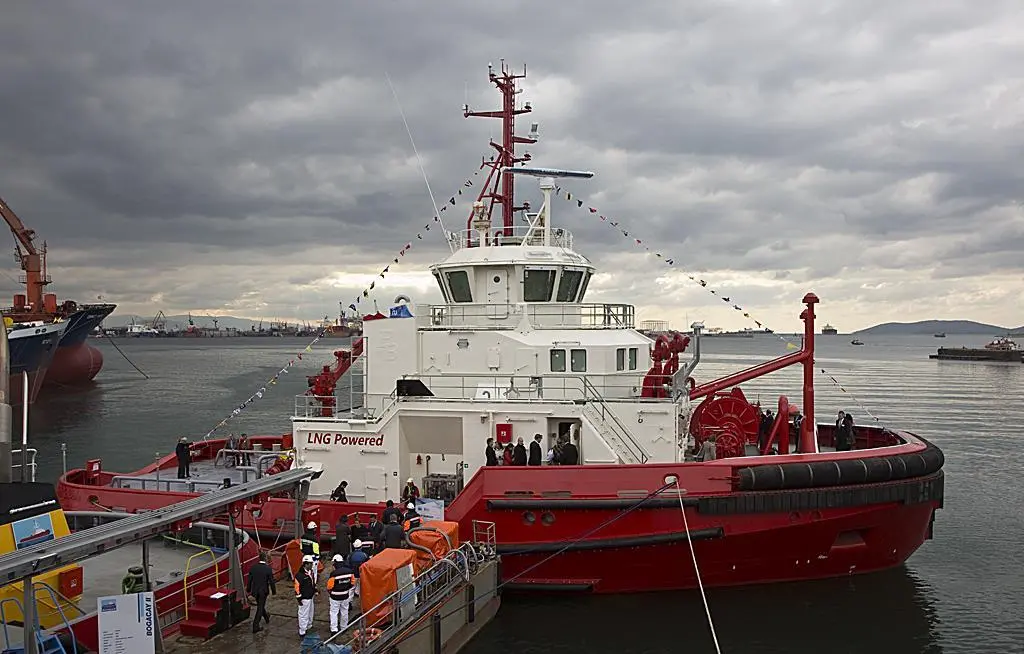
Among the first truly ‘green’ tug ideas came one from Wärtsilä, combining its ship design and propulsion departments to solve the dilemma of a wide power range with low emissions. One of the first solutions to be investigated was the use of liquefied natural gas (LNG) as fuel, a logical step bearing in mind the growing provision of LNG facilities in ports, and the increasing need for LNG terminals, which need their own tugs.
Although changing the fuel from MDO (marine diesel oil) to gas potentially cuts SOx and PM emissions to near zero and drastically reduces NOx, it does not solve the fuel efficiency problem. In fact LNG is at a disadvantage in a tug – certainly with the dual-fuel engines favoured by Wärtsilä – because gas engines typically offer a slower response time than diesel, and tugs need to go from near-zero to full power in a matter of seconds.
So the initial solution proposed was to use an electric drive, with a bank of batteries, i.e. a true hybrid concept. The ship could run on batteries alone while idling, producing zero emissions. Should more power be required, or the batteries require charging, one of both engines can be started. For the brief periods when high power is needed, invariably in short bursts, the combined power of the engines and batteries will allow an almost instant response, superior to a diesel tug.
Probably because of the high capital cost involved in building such a vessel, no hybrid LNG tugs have been ordered yet, although Wärtsilä has supplied dual fuel engines for tugs, notably a pair for China.
Hybrid tugs are in service, nevertheless. Foss Maritime of the USA has two in operation on the west coast the first hybrid tug, Carolyn Dorothy, uses diesel engines and a XeroPoint hybrid system from Aspin Kemp Associates (AKA) of Canada. This vessel has been in service in 2009, and in 2012 was joined by a second, Campbell Foss, converted from a conventional tug. The Campbell Foss suffered a fire in its battery compartment, which was thought to be the result of a software problem. It is believed that Foss is converting another tug, making three hybrids in its fleet.
In Europe, Kotug of Rotterdam put its first hybrid tug, R/T Adriaan, into service in 2012.This too uses the XeroPoint propulsion system, and was a conversion of an existing, 2010-built, tug. A shaft generator was in each of the three propulsion trains. The hybrid power switchboard was connected to the existing auxiliary generators, and a Corvus Energy lithium polymer battery pack, claimed to have 10 times the capacity and lifespan of lead acid batteries, was installed. The power management system is optimised to ensure efficient operation in all modes, and this is the key behind the XeroPoint technology.
The process of optimising the power management system, to ensure that the vessel operates efficiently in each of its hybrid modes, is essential. Experience with the R/T Adriaan shows that rather than the conventional tug operating pattern, with engines running at 100% load for a mere 2% of the time, the hybrid tugs is able to operate efficiently in all modes, with battery power – i.e zero emissions – being sufficient for idling and light running at speeds up to about 4.5knots. As extra power is needed, or when battery charging is required, the auxiliary generators cut in, with the main engines needed only for high bollard pull situations.
The reduced fuel consumption and clean combustion combine to produce a claimed overall 50% reduction in emissions.
The success of these hybrids has led to an order for two hybrid tugs to a design by Dutch operator Iskes and Offshore Ship Designers (OSD), being built by Damen. Research organisation Marin and operator Smit are also involved in this ‘green tug’ project. The ‘green tug’ will have a system offering diesel-electric or battery propulsion, via electric azimuthing thrusters, bow thruster and winch. Like the other hybrid propulsion concepts the power management system will be designed for fast response and seamless transitions between battery, diesel-electric and hybrid modes.
One of the latest ‘green’ tug deliveries has come from Turkish builder Sanmar, for Norwegian operator Buksér og Berging. The vessel, named Borgøy, is the first of two ordered by Buksér for operation at the Kårstø gas terminal, under contract to Statoil. The second tug, Bokn, is scheduled for delivery in 2014.
For LNG terminal tugs LNG fuel seems the logical choice, particularly as Statoil’s tender documents requested high environmental credentials, but there were economic and design challenges to be overcome. The cost of a gas-fuelled tug incurs a premium of some 40% to 50% over a conventional vessel, most of the extra cost coming from the fuel tanks and fuel system.
The tugs were designed by Buksér og Berging’s in-house team, with the assistance of Norwegian company Marine Design and with further input from Sanmar, the chosen builder. The 35m long ASD tugs have a 70t bollard pull.
Gas-only vs. dual-fuel
Rolls-Royce designed and supplied the propulsion and gas systems, comprising two Bergen C26:33L6PG engines, driving azimuthing thrusters, the C-type double-walled Aga Cryro 80m3 gas tank and the gas supply systems.
The Bergen engines are of gas-only design, rather than the dual-fuel option favoured by many other major builders. Rolls-Royce believes that LNG rather than MDO means lower maintenance costs, particularly on the fuel system; superior cleanliness; reduced lube oil consumption; and, in Norway in particular, tax benefits arising from the much-reduced emissions. Rolls-Royce says that the spark-ignited lean burn pure gas option has transient response equivalent to diesel engines, and it meets all current and future emissions limits, plus makes a significant impact on EEDI. It is simpler than a duel-fuel installation, less prone to methane slip (and thus higher GHG emissions) and operates on gas of 70 methane number, whereas dual fuel engines need at least 80.
The gas system is based on a vertically-mounted C-type double-layer tank – the double skin provides a degree of redundancy. As in Wärtsilä LNG tug concept, the vertical siting of the tank allows a safe distance from the hull sides to be maintained. The top support of the tank is designed to slide, accommodating thermal expansion.
Bill Thomson, Editor, The Motorship.
Related Articles
 EQUIPMENT
 ALTERNATIVE FUELS GREENPORT