![PortStrategy[GreenPort]](https://www.portstrategy.com/wp-content/uploads/2026/09/PortStrategyGreenPort.svg)

Baltimore bridge collapse shows need for resilience
The collapse of a bridge in Baltimore, Maryland after it was hit by a container ship is a ‘stark reminder’ of the need for resilience in the shipping industry, says the boss of a global container logistics platform.
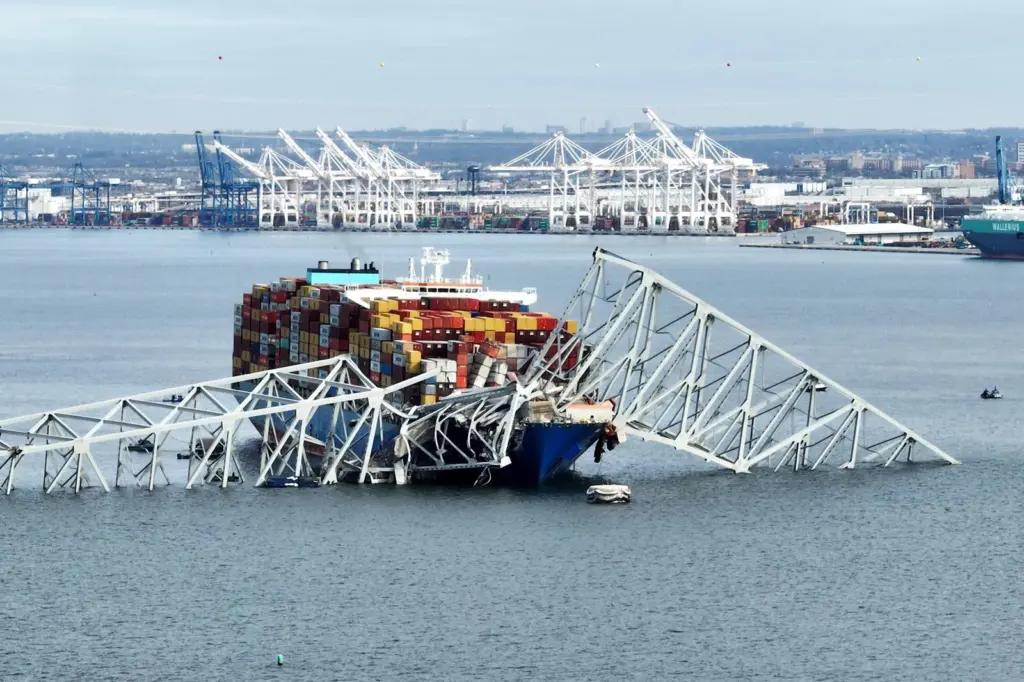
The Francis Scott Key Bridge collapsed in the early hours of 26 March when it was hit by the Dali, a 10,000 teu vessel operated by Synergy Group and time-chartered by Maersk. Two construction workers on the bridge at the time were pulled from the water and six are unaccounted for and presumed dead.
The Port of Baltimore has confirmed that traffic to and from the port has been suspended until further notice, with the port remaining open to process trucks at its terminals.
“The collapse of the Francis Scott Key Bridge is a stark reminder of the fragility of our infrastructure and the critical need for resilience in the face of unexpected events,” said Christian Roeloffs, co-founder and chief executive of Container xChange.
“As we navigate the aftermath, we are reminded that the container logistics industry centres around the critical need for robust risk management and resilience in supply chain operations.
“It highlights the importance of contingency planning, diversified routing options, and the integration of real-time tracking and analytics to mitigate the impacts of unforeseen events.
“This incident services as a reminder that infrastructure vulnerabilities can lead to disruptions and being prepared with flexible, adaptive strategies for maintaining continuity in the face of challenges.”
Significant disruption
Roeloffs goes on to say that the repercussions of the bridge collapse may cause significant supply chain disruption, particularly in the local area; higher transportation costs; a ripple-on effect on the local economy in terms of possible job losses and reduced business activity and delays and price increases for end customers.
Market analyst, FourKites, predicts that container traffic will be diverted to neighbouring ports. “Likely alternatives would be those in Norfolk, New York, New Jersy, Savannah and Charleston,” said Mike DeAngelis, senior director, international solutions, FourKites.
“It is too soon to know to what degree, but this will inevitably have an impact on the cargo flows and infrastructure on the US east coast.”
Related Articles
 WORLD
WORLD
 WORLD
WORLD
 PRODUCTS & SERVICES