![PortStrategy[GreenPort]](https://www.portstrategy.com/wp-content/uploads/2026/09/PortStrategyGreenPort.svg)





Ecuador: harmony sought
The turbulence now prevailing in Ecuador – spanning economics, business agility, security and other issues – is mirrored in the country’s maritime port sector which in recent years has a seen a significant injection of new capacity but left in its trail fundamental differences between the various terminals, particularly container terminals.
The differences are said by some to amount to a corrosive competitive imbalance between the terminals and especially those clustered in or around Guayaquil.
This competitive imbalance has, in turn, generated its own problems and challenges which have had a notable impact on the fruit exporting sector, now more important than ever to Ecuador’s economy. With the oil sector in decline – maturation of wells, lack of investment, uncertainty over production in Yasuni National Park etc. – fruit exports, and notably bananas for which Ecuador holds the status of No 1 exporter in the world, take on much more importance in the economic equation.
Yet, just as this situation is in play the logistics associated with fruit exports have become more challenging. The trigger point for this can be seen to be the recent decisions made independently by Maersk and MSC to relocate their terminal operations from ICTSI’s Contecon, Guayaquil facilities to DP World’s Posorja terminal and the Narportec terminal respectively.
Use of Posorja, the Banana Marketing and Export Association of Ecuador has calculated, entails an additional transport cost of US$130 per container.
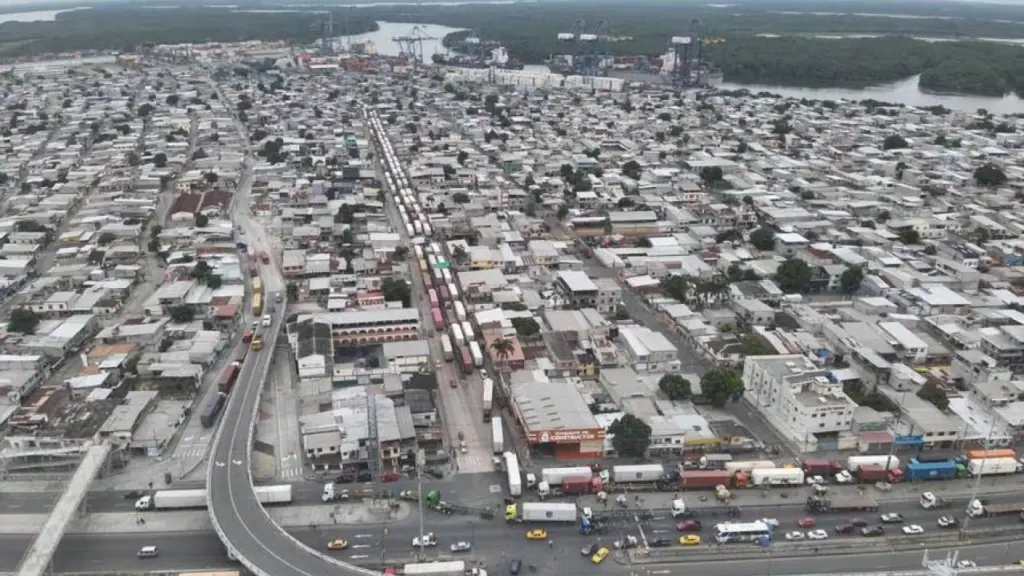
MSC’s decision to move to the Narportec terminal, owned by Dole, has generated massive congestion especially on peak days – Wednesdays, Thursdays and Fridays. Access to Narportec is via urban areas of Guayaquil and very narrow streets. With large traffic volumes congestion is inevitable. This means not inconsiderable costs resulting from delays plus truckers being exposed to theft, extortion and safety issues due to the current troubled security situation. The neighbouring terminal of Terminal Portuario de Guayaquil (TPG) is similarly adversely affected.
Such challenges add to an already lengthy list of difficulties that banana exporters in particular face, ranging from biosecurity issues such as preventing Fusarium to delays at the Panama Canal. It is also ironic that both extended and congested supply lines contribute to a further exacerbation of an already troubled security situation and allied to this greater opportunity for drug trafficking, now a major problem for Ecuador.
ORIGINS AND SOLUTIONS
Both Maersk and MSC moved their terminal operations with strengthening their margins in mind – an opportunity presented by the competitive imbalance between terminals. Compared to the original terminal facilities concessioned by the state to Contecon in 2007 other terminals such as Posorja and private terminals like the TPG and Narportec terminals operate under more favourable fee and tax regimes which give them more room for manoeuvre when it comes to attracting and retaining clients. National port masterplans or single port region masterplans often contain elements which aim to iron out the inevitable competitive differences between terminals which spring from a multitude of sources – the different timing of developments, a different legal basis for set-up, varying fees including some parties that do not have them relating to terminal occupation, different levels of applicability regarding rules and regulations that effect service delivery, differences in mandatory investment, insurance requirements and so on.
The combination of such factors can often result in big competitive differences between terminals. It is normal to address these through master-planning or other government-backed instruments. The objective is always a level playing field which leads to the tried and tested situation of market forces acting as an effective competition regulator.
The instruments used to build a healthy competitive climate should also be forward looking – if one party plans to add a major new slice of capacity what will the impact be? if it is a further development of an existing terminal, then is it appropriate to offer all the tax and other breaks given with the original terminal development?
Ecuador’s situation where it has diverse terminals that have come into service in different ways – for example Contecon via an international tender for the concession, DPW at Posorja via the direct award of a concession and TPG and Narportec as a privately-owned terminals – and which operate under different regimes is a classic one whereby intervention may be required to achieve the premier goal of a level playing field. This will ultimately strengthen supply chains and contribute to an improved economic and security situation, as well as a much-improved port sector investment climate underpinned by legal certainty – essential steps today in Ecuador.
Related Articles
 EQUIPMENT
 OPERATIONS
 OPERATIONS