

ASCs FOR ANTWERP AS EUROPE AUTOMATION INTEREST GROWS
Component parts of new automatic stacking cranes (ASCs) have started arriving at DP World’s Antwerp Gateway Terminal (AGT) in the Port of Antwerp.
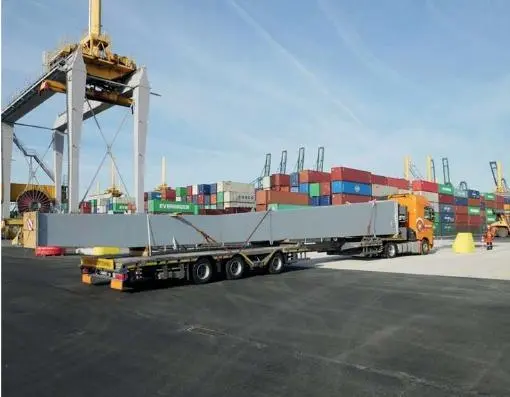
The new, rail-based, equipment is going to replace the traditional straddle carrier supported box stacks employed at the DP World terminal.
A key advantage of the new generation of ASC modules is the ability to place containers six high and up to nine units wide. This will offer DP World a capacity gain of 30 per cent compared to a straddle yard operation.
A total of 17 of the fully electric, fully automated ASC modules are going to be added over time in this location and represent a key part of a US$210 million investment that is intended to raise annual throughput capacity to a level of 3.4 million TEU/yr by 2026.
As Dirk Van den Bosch, CEO, DP World, AGT, explains, increasing capacity is only one part of the rationale for this investment. “The delivery of the new crane components is the starting point of the retrofitting of our terminal to achieve our maximum density in a CO2-neutral way. With these investments, we continue to play a pioneering role and create clear added value for the port of Antwerp.”
The automated stacking cranes when introduced at the terminal will operate using 100 per cent green electricity, mainly produced at the terminal by means of a wind turbine and a biogas plant. In turn, AGT has confirmed that this new investment will further help it reduce its CO2 emissions, per container move, beyond the 51 per cent already gained over the past 10 years.
Interest in automated container terminal operations continues to gain traction in North Europe, with the opportunity to generate a more positive environmental impact providing added impetus.
German ports are a good example. More battery-powered automated guided vehicles (AGVs) have arrived at the HHLA Container Terminal Altenwerder in Hamburg and are driving forward the electrification of the fleet. This initiative, due for completion by 2023, will result in an annual reduction in emissions of approximately 15,500 tonnes of CO2 and 118 tonnes of nitrogen oxide.
At the same time, EUROGATE Container Terminal Wilhelmshaven (CTW) has confirmed plans to invest US$170 million to convert its container handling operations from a manual process to an automated system, with its first automated berthing operations set to commence during 2024.
Related Articles
 OPERATIONS
 OPERATIONS
 OPERATIONS