Mobile harbour crane manufacturers are targeting lower emissions through greater use of advanced electrical drive systems
Sector analysis: electric, technology, flexibility
The mobile crane industry is an integral part of the port business on a global basis, offering flexibility for many terminal operators to load/discharge a wide range of cargoes, including containers and bulk goods.
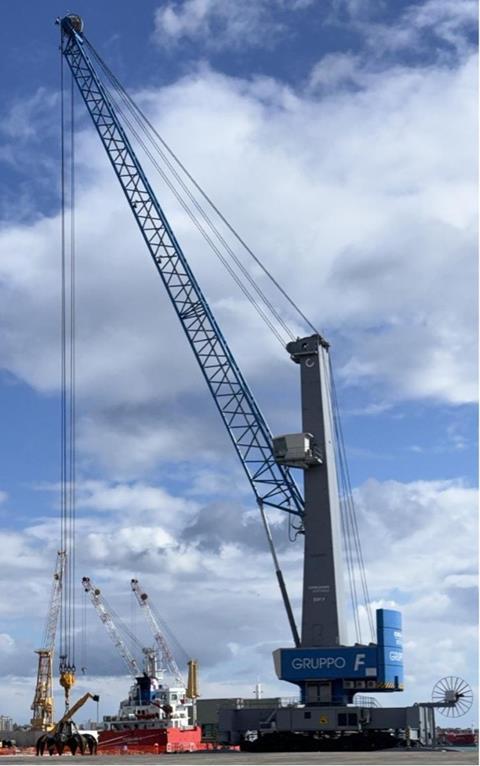
Current trends are replicating activities of other equipment manufacturers, with a very strong focus on greater use of technology and power supply from electricity while retaining flexibility to meet all customer needs. A good example of this can be noted at the Port of Augusta, Italy, where Gruppo FF has acquired a new multi-cargo-use ESP 9 unit from Konecranes that is powered by two generator sets and can also be operated using shore-based electricity.
There is a strong desire from mobile crane manufacturers to increase use of electricity for crane power, along with improving environmentally friendly systems. However, targeting zero emissions must always be balanced with the continued need to deliver to their customers the maximum flexibility of lifting capabilities and equipment safety. The following company by company review highlights recent initiatives.
DATA ANALYSIS: ELECTRIC CUSTOMER DEMAND, MAXIMISING FLEXIBILITY
Liebherr: Wide product range, with a tag line of having the “right crane to suit every requirement,” and operates with a designated maritime crane division. Versatile drive systems are utilised in all maritime cranes and when equipped with electric drives are able to deliver emission-free activities as well as ensure lower operating costs. Hybrid drives are a standard part of the mobile harbour crane portfolio. Liebherr has developed an electric-hydrostatic drive to complement the all-electric drive. This drive type is connected to the local power grid, too, which allows for locally zero-emission operations. The drive concept offers two methods of power recuperation - energy recovered during lowering can be fed into the local power grid or alternatively stored in the hydraulic Pactronic system to be retrieved when needed.
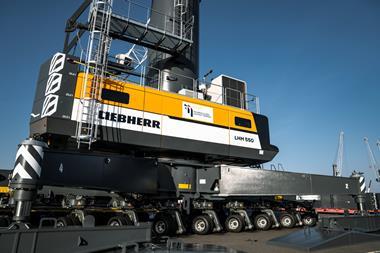
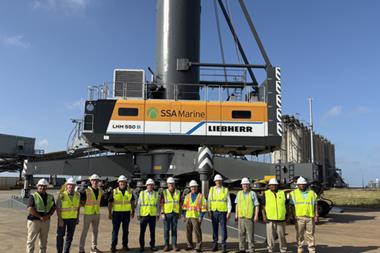
The Port of Constanța recently received two Liebherr LHM 600 units, which have specially engineered double supporting pads to maintain stability during high-capacity lifts thereby adapting the cranes to the structural requirements of Constanța’s berth. Each of these LHM 600 units operates primarily on an advanced electric drive system and can perform tandem lifts of up to 400 tonnes. At the same time, three LHM 550 units are being deployed across Seaboard Marine terminals in Miami and Houston. Each unit has electric drive capabilities for future shore-power initiatives, while hydrostatic drive technology in place delivers smooth, efficient performance operations.
Konecranes Gottwald Mobile Harbor Cranes: Key focus remains on the provision of cost-effective and eco-efficient cargo handling via use of an electric drive concept. With innovative solutions such as smart crane features, connectivity and digitalisation, the approach is to combine the machine with intelligence for great performance and high serviceability for all types of cargo, including containers and bulks. The latest Konecranes 6 product range is described by the company as: “Summarised in our DNA: electric-smart-powerful. In short: ESP.” Electric is the cornerstone of the products offered by this manufacturer through use of premium technology supporting functionality like electronic power supply, innovative battery drives and on-board drive units with hybrid solutions.
APM Terminals has ordered two Gottwald ESP 7 mobile harbour cranes for its Terminal de Contenedores de Yucatan facility in the Mexican port of Puerto Progreso. The order was booked in the final quarter of 2025 with the units scheduled for delivery in September 2026. Both are part of the Ecolifting initiative, the ongoing roadmap by Konecranes to deliver zero tailpipe emissions and support the decarbonisation of port operations.
The new Konecranes ESP 9 crane at the Port of Augusta can lift up to 200 tonnes under hook. “It is the first of its class in Italy with this lifting capacity,” states the terminal operator, Consortium of Maritime Works Port Activities (C.O.M.A.P). The company further notes that in addition to the flexibility of power options such as shore power, the ability to handle different types of cargo is crucial: “Our experience with the crane to date has been entirely positive, with low fuel consumption and high operating speeds. It has, for example, been used for scrap loading and for the unloading of 110-tonne turbines.”
Italgru: Well-established manufacturer, operating since 1954, Italgru serves Italian and international markets and retains a clear focus of flexibility and sustainability. The company says its electric cranes are the “result of careful studies and accurate tests” and target the delivery of energy-efficient technology. Italgru has an ethos of “One Machine, Multiple application” with multifunctionality a key part of the equipment’s value proposition because of the ability to exchange lifting attachments quickly due to the simplified modular structure. As such, Italgru says that its equipment has the flexibility to handle bulk materials, steel or scrap metal, general / project cargo and containers.
Italgru’s recent growth is supported by several key innovations. These include Green Solution Electrification, which means all IMHC models now feature an electric-over-hydraulic drive option and can be run on mains power when berthed, supplemented by a diesel generator. Another initiative is Energy Recovery whereby newer units include hydraulic energy accumulators that store energy during the lowering of loads and deceleration, reducing overall fuel consumption, while Telemaintenance can monitor its global fleet via real-time troubleshooting directly from Italgru headquarters in Ambivere, thereby improving uptime.
SENNEBOGEN: In operation for almost 75 years, the company says that it “unites tradition and innovation” across its key locations in Bavaria, Germany. Electrical power and green-hybrid regenerative power are two areas of continuous focus for port cranes. SENNEBOGEN states that there are many options on the market for electrification but there is not yet one ideal solution. Its electro-hydraulic approach is claimed to help reduce operating costs by up to 50%. With an assumed 2000 operating hours per annum and energy generation from renewable sources (i.e. when the operator lowers the boom, the system stores the energy in the system and makes it available for the next lift with virtually no loss) the company states that battery power can save each piece of equipment generating up to 50 tonnes of CO2 yearly.
Another important factor highlighted by SENNEBOGEN is service intervals. A diesel engine has around 500 hours of operational time before preventative maintenance is needed, which compares with 10,000-20,000 hours for its electro-hydraulic system. İzmir Demir Çelik Sanayi A.Ş. in Turkey affirms this position. “We reduced our energy costs by up to 80% after converting the machine from diesel to electric, without any loss in performance”, underlines Emre Söyler, Port Manager.