




PROPANE: GAME ON?*
Propane as a power source is getting more attention in the USA but the road ahead still has to meet the challenge of propane being regarded as a clean fuel but not a zero emissions one

US ports have the potential to shift more of their energy consumption to propane, and it’s a trend which appears to be gaining acceptance.
Generally, users of propane embrace it because it has three unimpeachable virtues: it’s affordable, clean and produced entirely in the US.
There is a long list of applications which could see increased usage by ports and terminals: powering forklifts; terminal tractors, back-up power generation, cold ironing, barge power and so on. Additionally, there is a long list of applications where propane has the potential to extend its reach with this including diverse cargo handling equipment and horizontal transport applications.
A key incentive to take up the propane option is that it helps improve air quality. When measured, propane does better than gasoline(1) on greenhouse gas (GHG) emissions, for example, 12 per cent(2) less with terminal tractors and light duty vehicles.
Propane is already being used to fuel resilient, low-NOx generators for backup and in prime power for cold ironing, charging and other large industrial applications.
Another factor working in propane’s favour is that it can be produced from organic and renewable sources. It is non-toxic, does not contaminate air, soil, or water resources.
Specifically, attractive environmental benefits in a port environment are lower Particulate Matter (PM), reduced nitrogen oxides (NOx) emissions and lower sulfur oxides (SOx) emissions. Forklifts powered by propane emit 76 per cent less SOx than electricity drawn from the grid.
With the onslaught of climate change, the choice has become clearer, especially when the facts about propane emissions are compared with the total emissions generated by diesel, or by gasoline, or by electric power that is generated in a coal-fired or gas-fired power plant.
There are also economic benefits. When compared with gasoline-powered vehicles or diesel-powered vehicles, propane delivers a lower total cost of ownership. This is made possible by a menu of advantages: a low-cost refuelling infrastructure; competitive upfront costs, low maintenance and operating costs.
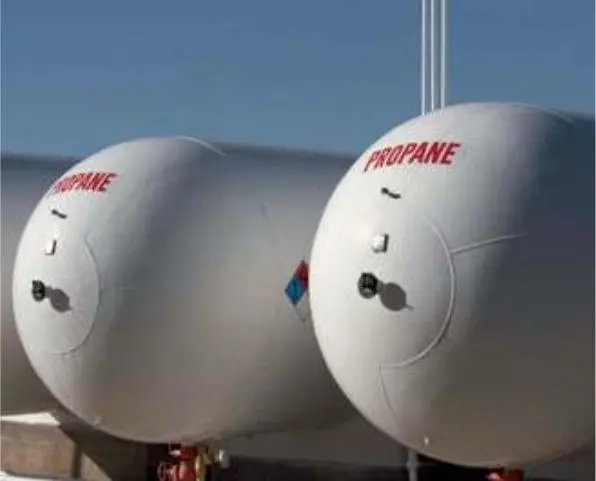
Propane-powered ultra-low NOx engines for medium duty levels are now commercially available, thanks to a major move by Cummins Engine Corp. Introduced earlier this year, the Cummins B6.7 propane auto gas engine is said to offer high performance with low carbon characteristics.
On-site refueling at ports can be achieved competitively plus propane itself typically costs less than conventional and other alternative fuels. Construction cost estimates for a 1000 to 3000 gallon propane tank station are US$30,000-US$50,000. This budget includes crash posts, seismic engineering and installation. An 18,000-30,000-gallon propane tank station costs US$100,000-US$150,000. This kind of infrastructure budget is reported to be less than other alternative fuel sources. Plus, propane has an additional advantage: a minimal footprint within a facility, with no utility service upgrades.
According to Tucker Perkins, President/CEO of the Propane Education & Research Council (PERC), the “propane engines of today have near zero emissions. This,” he says, “is a unique opportunity for our equipment partners to decarbonise ports infrastructure. PERC, he points out, “is ready to support the ports, the equipment manufacturers, and our marketers who serve this important growing market segment.”
Interestingly, Joe Calhoun, Director Business Development, PERC, has also been cited in recent media coverage as noting that there are now at least three manufacturers of terminal tractors looking at propane powered units one of which is South Carolina based TICO, the tractor and trailer system manufacturer. He goes on to enthusiastically highlight the potential for propane use with other items of cargo handling equipment and at a wider level.
The recent Infrastructure Investment and Jobs Act of 2021 (IJIA), which President Biden signed into law on November 15, 2021, is also seen to present opportunities for ports and terminals to take up the propane power option.
IJIA authorises more than US$1.2 trillion designed to improve US infrastructure. Furthermore, the law creates an unprecedented opportunity for propane and other low-emission fuels to power on-road and off-road fleets that have historically operated on diesel and gasoline.IJIA includes over US$9 billion in funding for refuelling infrastructure and clean vehicles, including propane, which is identified in the IJIA as an emerging alternative fuel.
*Author: Gordon Feller. Gordon was appointed by the Obama/Biden White House to serve on the Federal Comm’ created by the US Congress to look at emerging energy solutions. He is currently completing a project for the US government’s National Inst. of Standards and Technology and serves as a Global Fellow at The Smithsonian Institution
Related Articles
 DIGITAL
 PRODUCTS & SERVICES
 PRODUCTS & SERVICES