


Russia builds dredge capacity
Russia is setting about an ambitious dredger newbuilding programme. The jury is out on whether it will work – the scale of the works and technical issues are challenging. Oleksandr Gavrylyuk reports
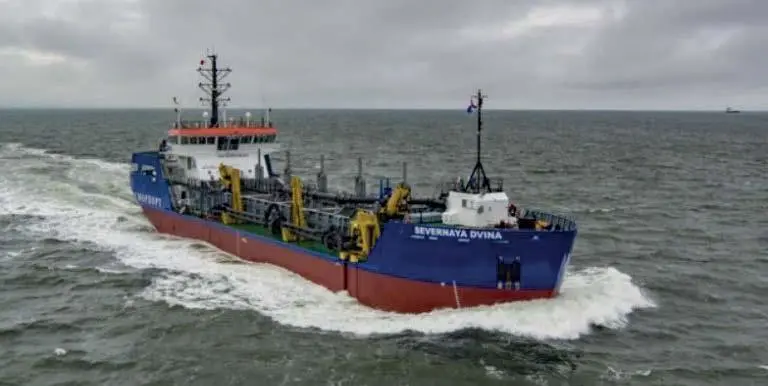
This year, Alliance, a privately held towing and tugboat company operating at Russia’s key Baltic seaport of St Petersburg, has bought a foreign-made non-self-propelled dredger to enter the domestic dredging market.
With its 16 cubic-meter large bucket, the new machine will be one of just three dredgers of the type available in the world’s largest country extending throughout the bulk of the Eurasian Continent, according to Aleksey Milovantsev. Director General, Alliance.
Meanwhile, Hydrographic Company (HC), a subdivision of the state nuclear energy corporation RosAtom, is going to acquire two dredging vessels this year. The company plans to excavate 10 million cubic metres of spoil under five various projects to be accomplished in Russia’s Arctic waters in 2023. With part of the works to be delegated to overseas (most likely – Chinese) contractors, the two dredgers will be instrumental in performing the remaining scope.
With HC forecast to need at least a dozen dredgers for its Arctic undertakings by 2026–2027, it plans to start placing orders for their construction with domestic yards. It has, according to Aleksandr Bengert, Director General, HC, already been in talks with Russia’s leading United Shipbuilding Corporation (USC).
In general, Russia’s dredging fleet has long ago become obsolete and thus incapable of meeting formidable challenges. Prior to Moscow’s invasion of Ukraine, it was mainly Van Oord, Boskalis, Jan de Nul and DEME that carried out the most ambitious projects in Russia. However, with the launch of the Kremlin’s unprovoked and brutal war, the Big Four European dredging operators were forced to withdraw from Russia. As a result, Russia has faced an acute shortage of dredging capacity and soaring prices for dredging works.
For instance, the aggregate capacity of all the domestic hopper dredges makes up only 39,000 cubic metres compared with 240,000 cubic metres of that of Belgium’s DEME alone, while dredging works rose by 30 per cent in price last year, according to the estimate of Aleksandr Bengert.
In the meantime, Moscow is determined to grow its seaports’ infrastructure and expand handling capacity despite western economic sanctions. Last year, the total annual capacity of its harbours increased by 36.6 million to 1.3 billion tonnes. This year, it is expected to grow four per cent more and keep expanding in the immediate future.
KEY PROJECTS
Such a growth scenario requires a large amount of dredging works. Specifically, RosAtom, which is in charge of improving the nation’s Arctic infrastructure, is supposed to arrange the excavation of 13.5 (including the 10 by HC) million cubic metres of spoil all along the Northern Sea Route (Russia’s part of the Northeast Passage) this year.
RosMorPort, an arm of the country’s transport ministry responsible for the comprehensive development of the country’s seaports’ infrastructure, is intending to orchestrate the dredging of 23.9 million cubic metres this year, up three per cent on 2022, as reported by Andrey Boldorev, Head of RosMorPort’s Investment and Strategic Development Department. Half of the figure, or about 12 million cubic metres, will be extracted from the Volga-Caspian Sea Navigation Canal to make it 4.5 metres-deep and, in such a way, navigable within the International North-South Transport Corridor (INSTC). Last year, the canal saw the removal of five million cubic metres, making it 4.2m deep.
To achieve its goals, the Kremlin has to upgrade and replenish its dredging facilities. For example, just for internal waterways, it is planned to construct 101 technical vessels by 2024, including eight dredging, 54 service, 27 sounding, six ecological and six auxiliary ones.
Building the new ships, however, is not going to be an easily achievable task. From 2019 to 2022 (i.e. before Moscow’s full- scale aggression against Kyiv and the successive exodus of the European dredging operators from Russia), 25 such vessels were built in Russia, comprising just four dredging, six service, 14 sounding and one ecological one.
Nonetheless, Moscow is trying to begin producing its own hopper dredges. RosMorPort is about to initiate devising a 1000 cubic meters capacity hopper dredge this year. The federal enterprise has incorporated the construction of two such machines for the Caspian Sea and that of Azov respectively into its investment programme for 2025–2029. In addition, the St Petersburg-based Almaz design office is going to start originating a concept for a 95m-long and 17m-wide dredge with a deadweight of 5500 tonnes, displacement of 9200 tonnes and hopper capacity of 4000 cubic meters, in order for the first vessel to be delivered in 2027. After testing the new machine, the design office is planning to proceed to develop a design for a 117m-long and 21m-wide dredge with its deadweight of 10,700 tonnes, displacement of 17,500 tonnes and hopper capacity of 8000 cubic meters.
All these things will take time. Yet, RosMorPort needs to deploy up to 20 dredges already this year to deepen only the internal waterways. As it does not have the sufficient quantity, it is going to enlist the missing capacity from private companies.
Related Articles
 DIGITAL
 PRODUCTS & SERVICES
 PRODUCTS & SERVICES