

The Namibian Ports Authority (Namport), has announced a new green partnership with the government of South Korea to support the Namibia–Korea Green Port Strategy Programme, the country’s ten year green port transition plan, writes Shem Oirere.
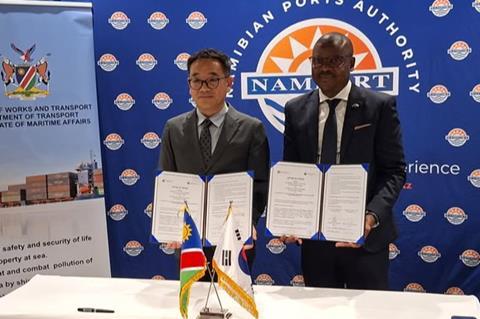
This new green partnership will involve work through the International Port Development Cooperation Programme (IPDCP), a Korean government-led initiative launched in 2008 to support port development in partner countries such as Namibia.
It’s an initiative which entails offering technical and financial backing for the develoment of masterplans and carrying out feasibility studies in port greening projects.
Strategic partnerships
The new partnership follows in the footsteps of similar ones with the European Union (EU) and the African Development Bank (AfDB) that are all aimed at transitioning of both Walvis Bay and Luderitz ports to be among the most modern green maritime gateways in Africa.
In December 2025, the EU, which has an existing strategic partnership with Namibia on sustainable raw materials value chains and renewable hydrogen, signed a NAD 13 million (GBP £583,500) partnership between the Port of Rotterdam, the largest seaport in Europe and the world’s largest seaport outside of Asia, and Namport, to support the planning of the Lüderitz Port expansion project in Angra Point.
The Port of Rotterdam has committed to support Namport develop Luderitz into a green hydrogen export hub and facilitate the forecast growth of a green hydrogen supply chain between Namibia and the Netherlands.
Rotterdam has already supported Namport in updating of the master plan for the expansion of Lüderitz’s Angra Point area with several recommendations such as the three-year expansion of the current quay wall in Robert Harbour by 200 to 300 metres to accommodate oil and gas, green hydrogen and manganese-related cargo activities at an estimated cost of NAD 2 billion (GBP £89,800,000).
In addition, the EU had in a previous deal with Namibia, financed the cooperation between Port of Antwerp-Bruges International (POABI), an affiliate of Belgium-based Antwerp Port Authority and Namport for the development of a master plan for the expansion of Walvis Bay Port targeting doubling of the port’s capacity and attract at least NAD 10 billion (GBP 448,830,000) in potential public private investments.
The EU has said that the expansion of both ports is aimed at strengthening “strategic trade corridors between Africa and Europe, positioning Namibia as a key regional gateway for sustainable trade and a future green logistics hub within global green maritime corridors.”
Transformative journey
Namibian ports then are on a transformative journey backed by international support and investment. of which the partnership with South Korea is the latest.
Namport’s CEO Andrew Kanime says that Namibia’s new maritime partnership with South Korea is “not the end of a process, but the beginning of a transformative journey and with this partnership, our ports will become greener, cleaner, safer and more competitive, while supporting economic growth and protecting our environment.”
Namibia, which has been striving to achieve sustainable and climate-resilient port operations, resolved in March 2022 to push for an implementable strategy that would transform both the ports of Walvis Bay and Luderitz into environmentally friendly gateways placing them and the country “at the forefront of Africa’s green port transition.”
Namport is also optimistic that Namibia’s location at the intersection of global trade routes and regional corridors will allow the operator to take advantage of the emerging green hydrogen industry, decarbonising port operations and developing the ports as regional bunkering hubs.
With the new Namibia–Korea Green Port Strategy Programme and assured backing from the African Development Bank and South Korea’s Ministry of Oceans and Fisheries, Namibia has an opportunity to accelerate renewable energy adoption, reduce emissions, strengthen climate resilience and protect its coastal ecosystems as part of Namport’s wider maritime transportation plan.